Press kit · Pressematerial
Press kit
Fact sheet, descriptions and images for editorial coverage.
In one paragraph
Idle Collider: Higgs Hunt is an incremental game about real particle physics for iPhone. You run a particle accelerator, time your beam to the bunch crossings and collect 26 particles, from the photon to the Higgs boson. Every collision is drawn as an event display, the way physicists see it. The LHC ring is free to play, with no ads.
Fact sheet
- Title
- Idle Collider: Higgs Hunt
- Genre
- Incremental / idle game, particle physics
- Platform
- iPhone (App Store). Android is planned for later.
- Release
- October 2026
- Price
- Free download. Ring 1 (LHC) is free with no time limit. One optional one-time purchase (3.99 € or local equivalent) unlocks rings 2–7.
- Business model
- No ads, no subscriptions, no account, no data collected. Particles are never for sale.
- Languages
- English, German, Simplified Chinese, Japanese, Korean, Spanish, French, Portuguese (Brazil), Italian
- Developer
- Nicolai Emig, solo developer, Germany
- Website
- idlecollider.com
- App Store
- apps.apple.com/app/id6819080461
Description
You run a particle accelerator. Tap in time with the bunch crossings, make collisions, and turn the data and the particles you find into stronger magnets, better detectors and bigger rings. After about a minute the machine keeps colliding on its own, also while the app is closed.
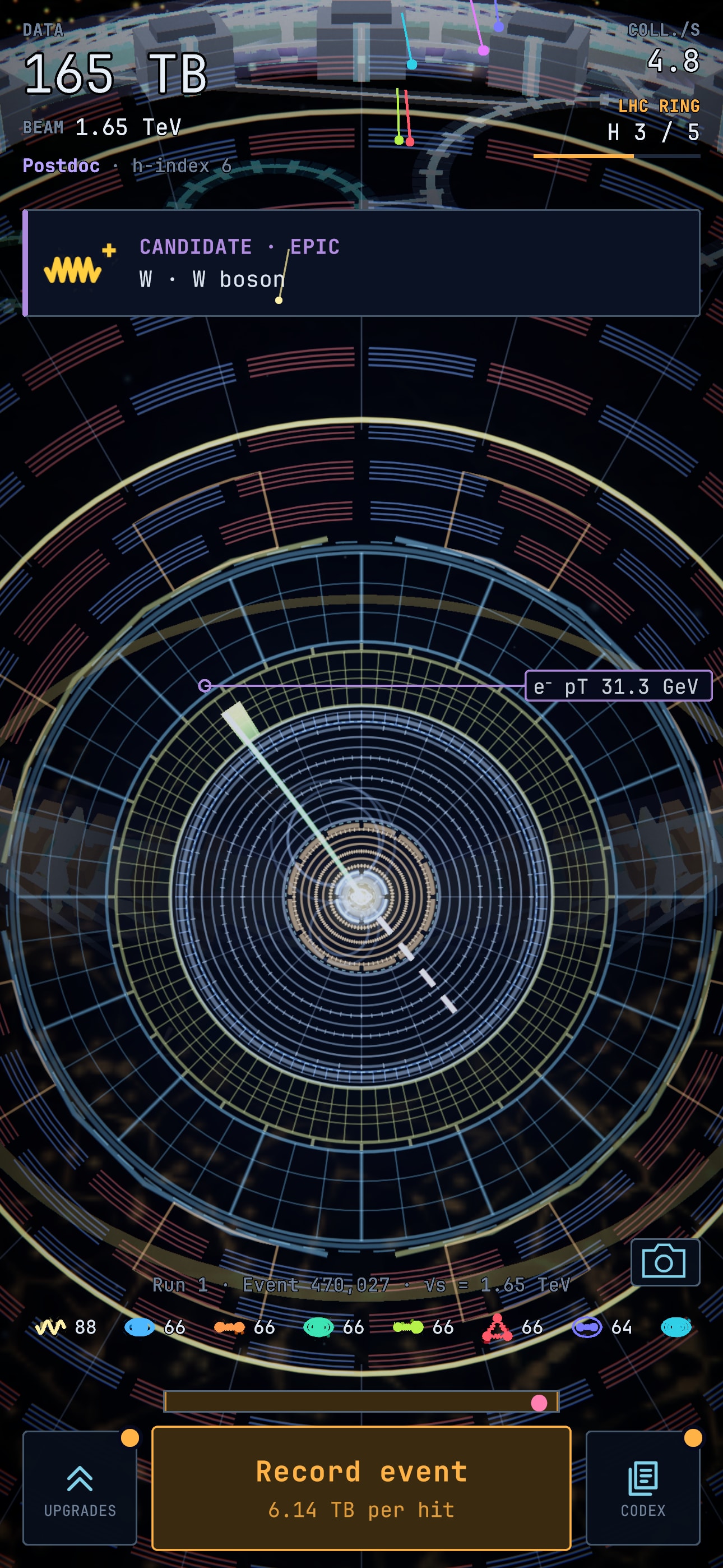
The codex holds 26 particles: 13 real ones from the Standard Model, from the photon to the top quark, each with a checkable fact, and 13 hypothetical ones such as the axion, the magnetic monopole or the WIMP. Everything that is only theory is labelled hypothetical. Professor Quark, a pixel-art physicist with a dry sense of humour, explains what you are looking at.
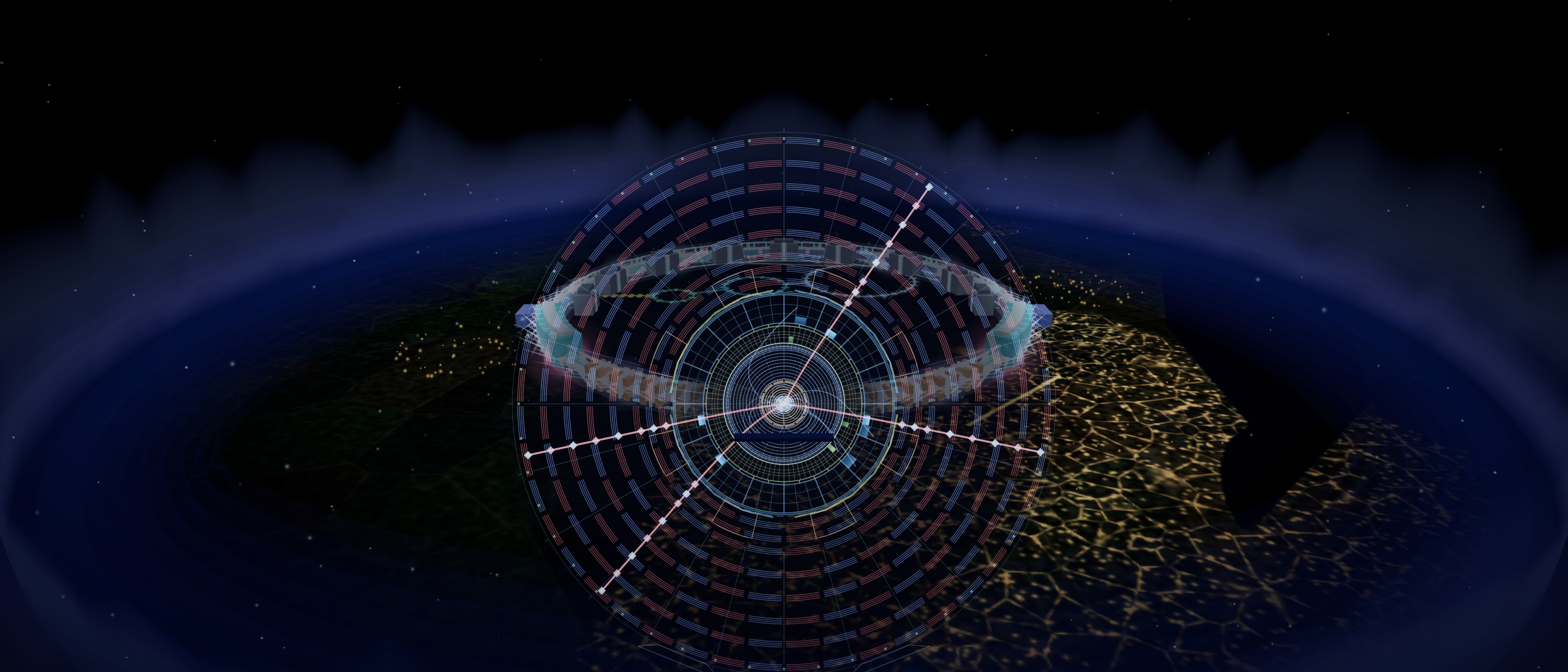
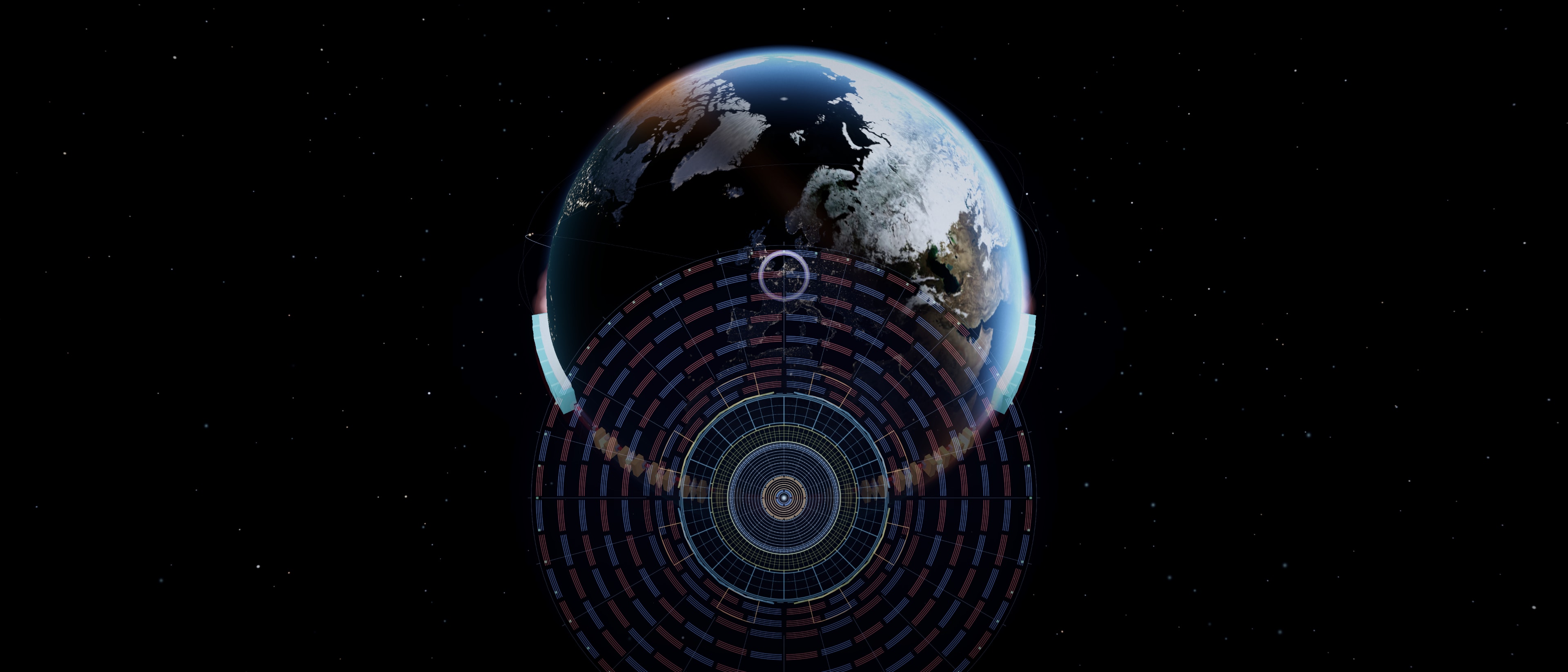
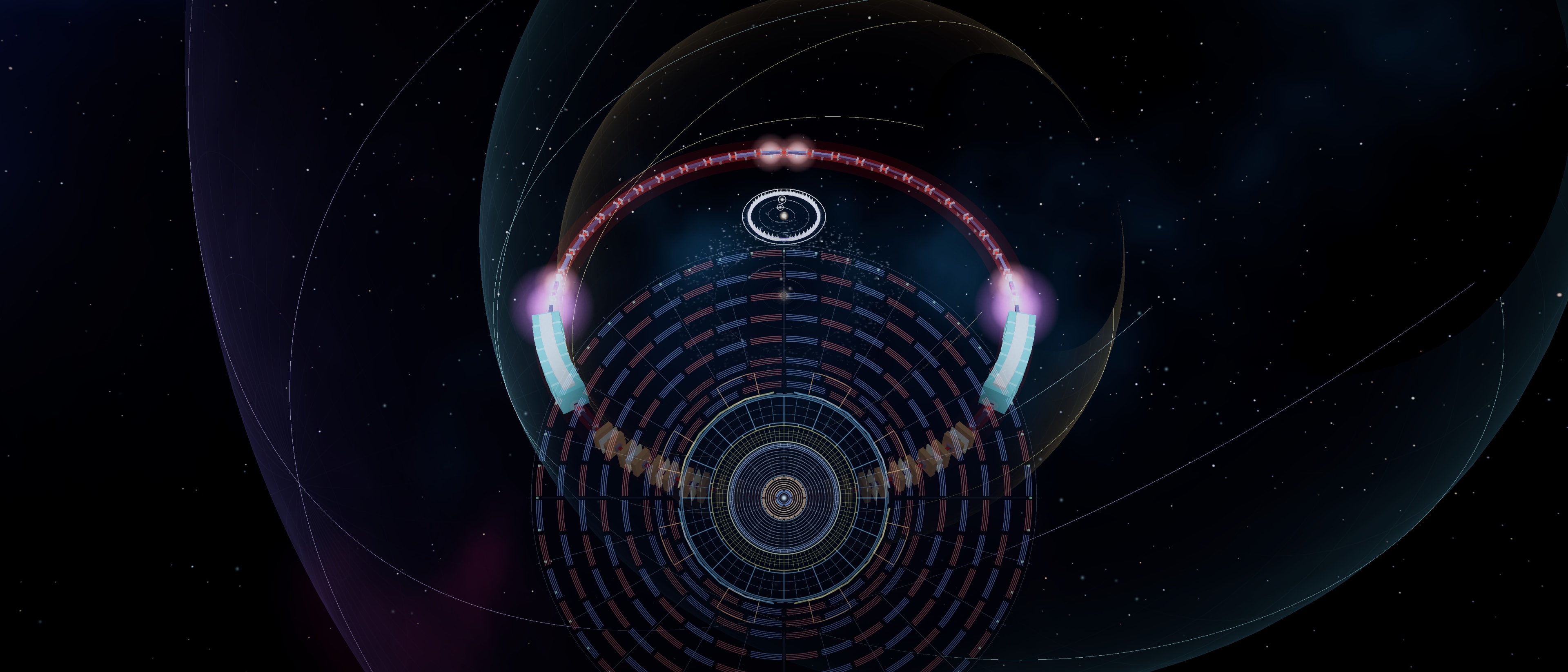
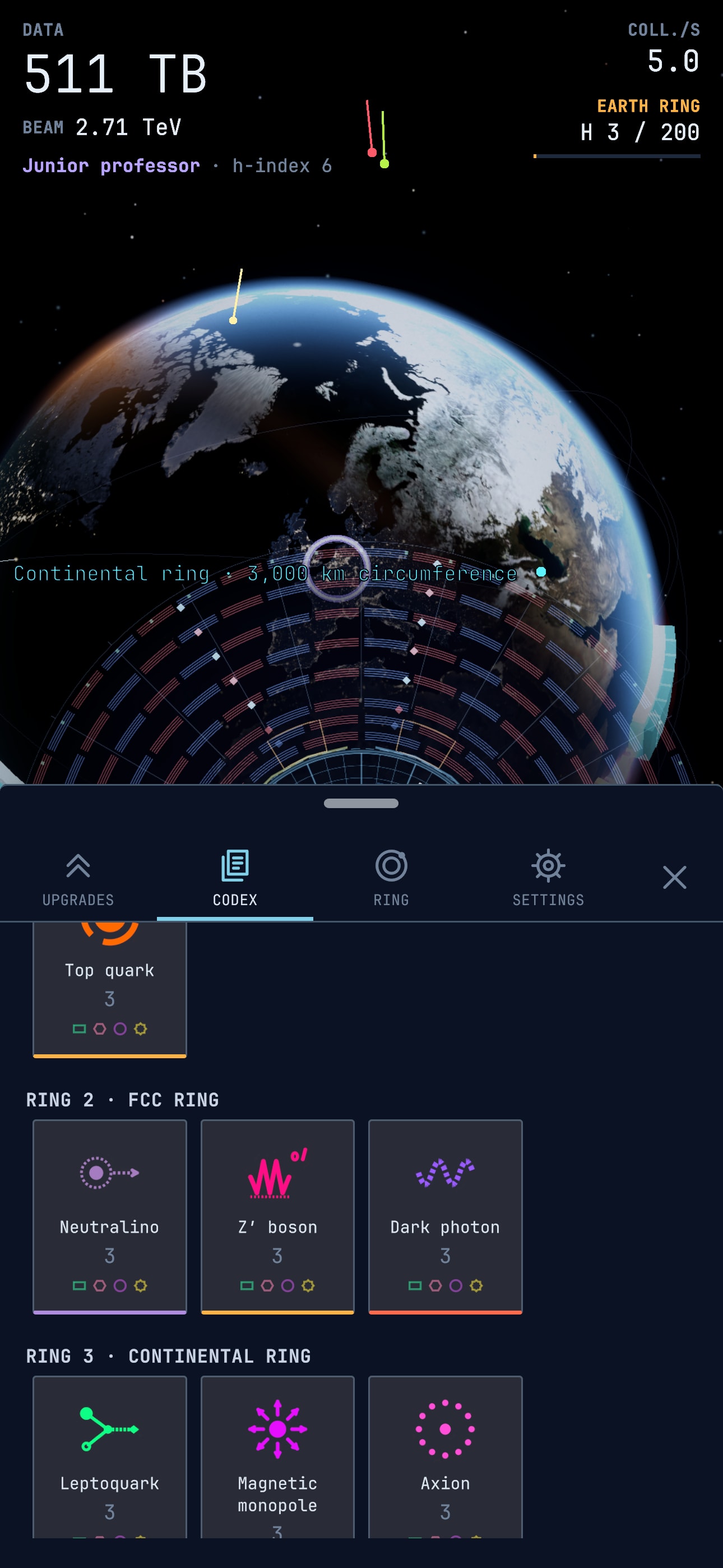
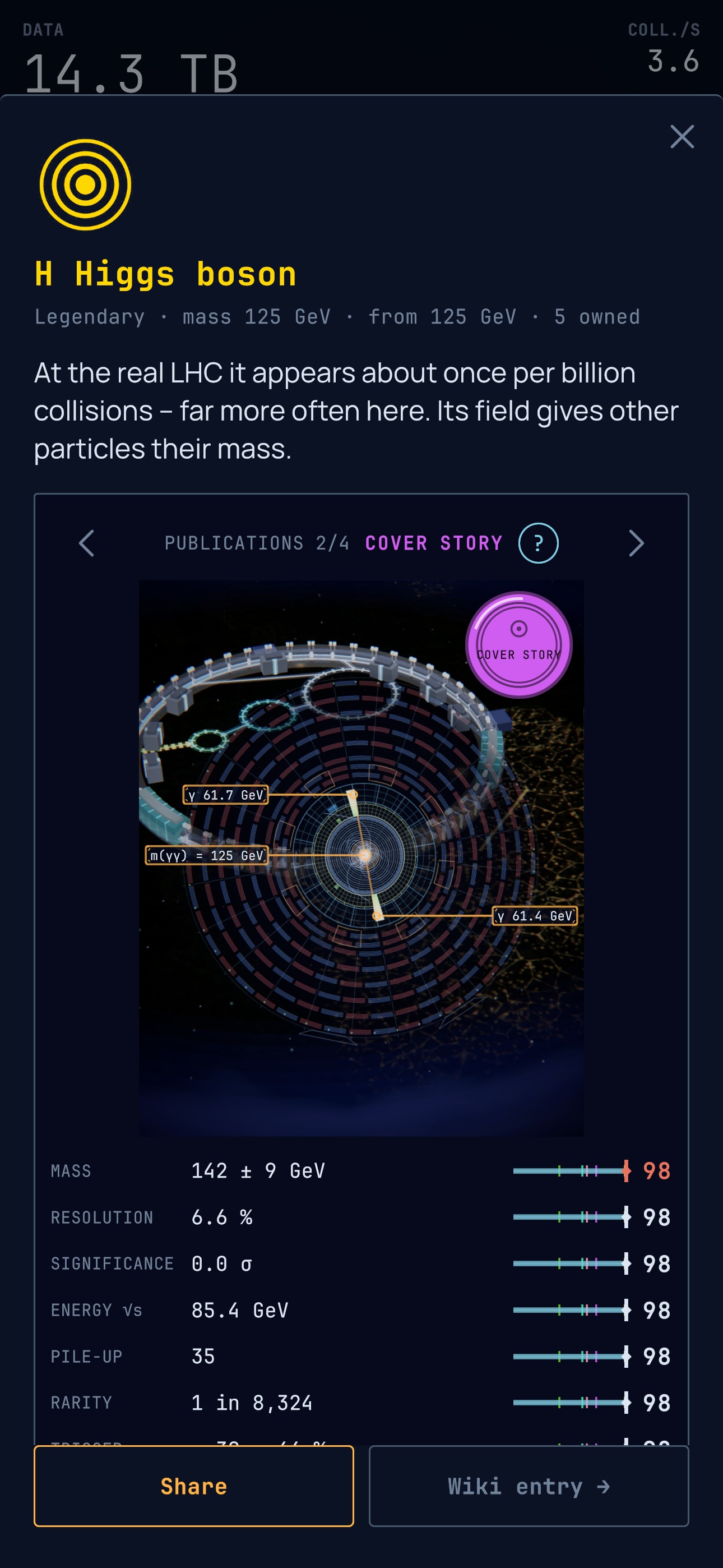
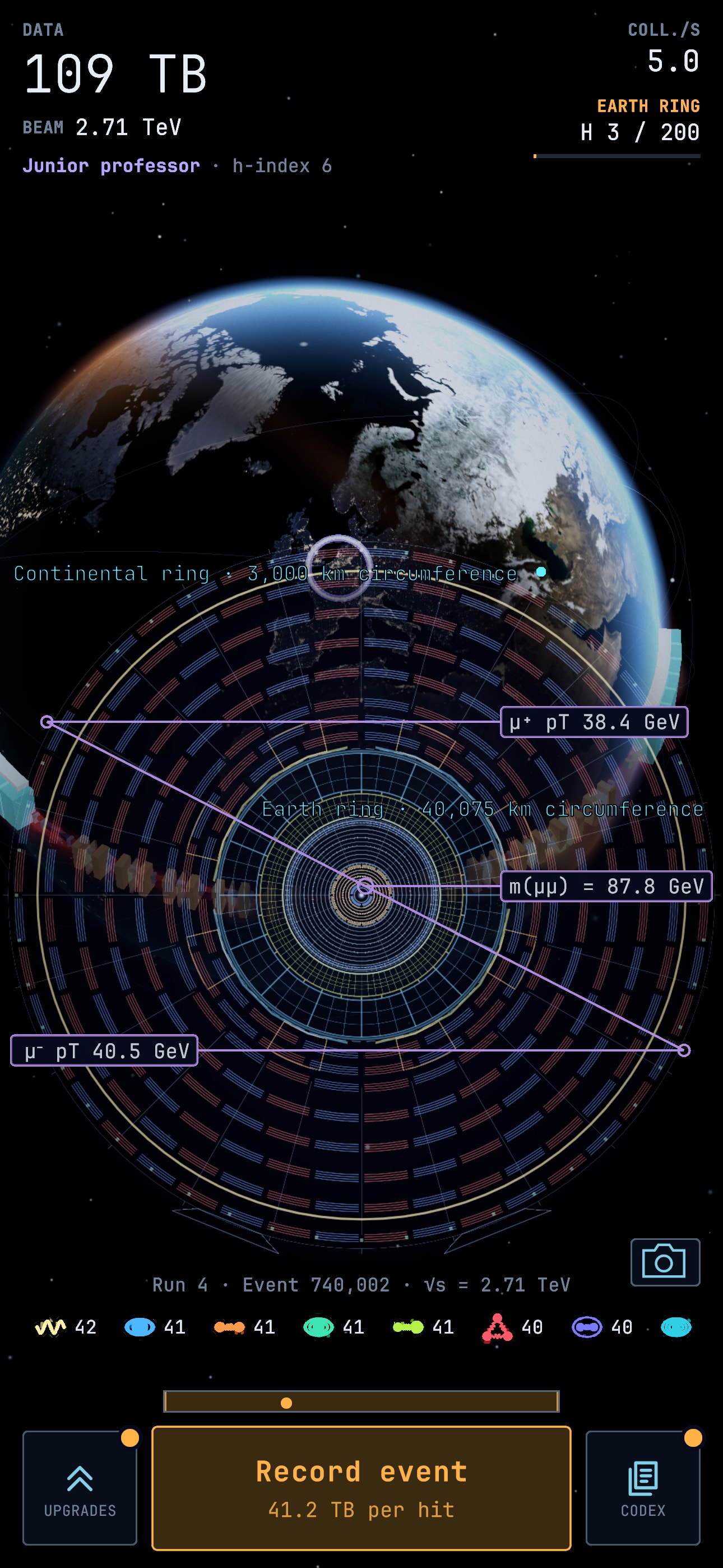
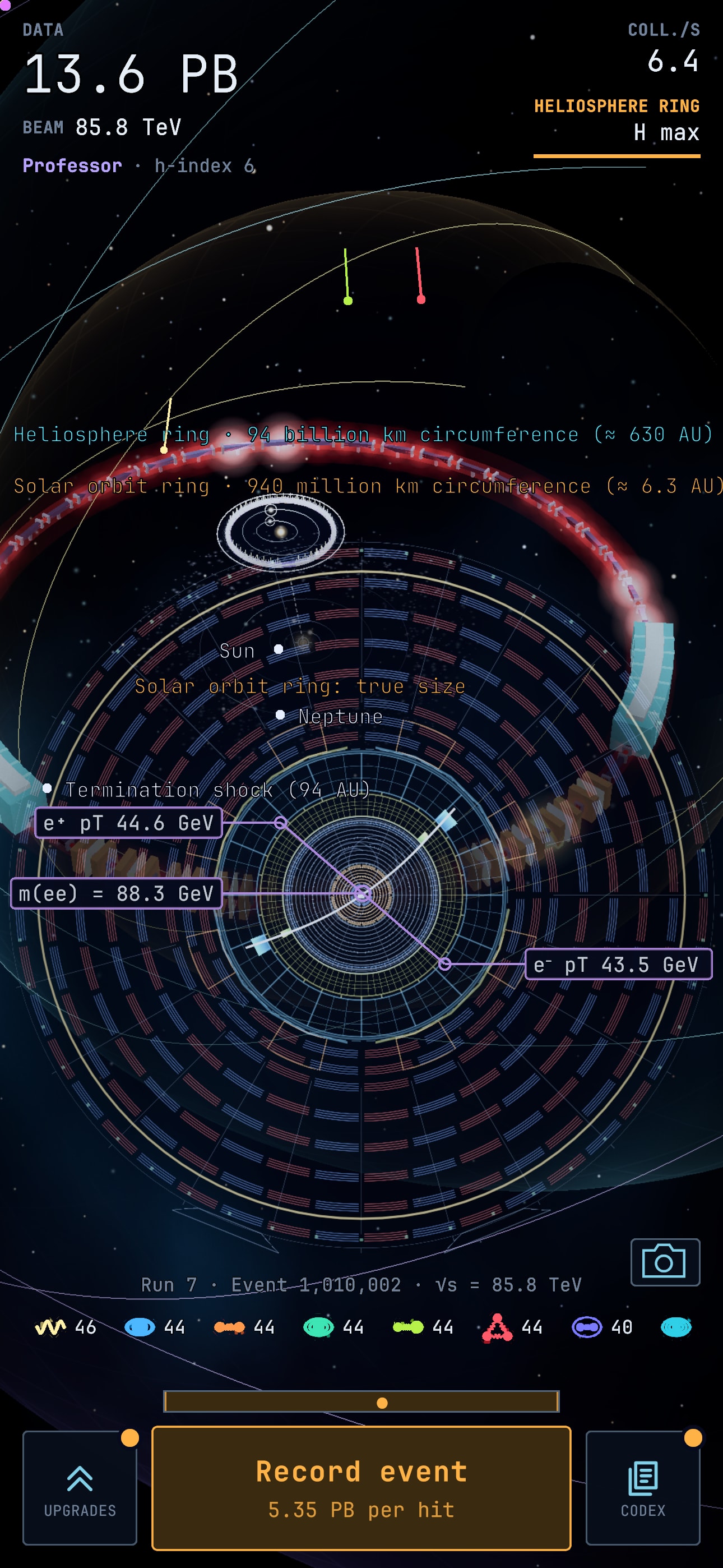
Seven rings are drawn in true scale: the 27 km LHC, the planned FCC, and fictional rings around a continent, the Earth, along the Moon’s orbit and around the Sun, out to the heliosphere. Each recorded event gets seven measured values and a verdict from raw data up to Nobel Prize, and the best ones become shareable posters. A research career with publications, citations and an h-index runs alongside.
What sets it apart
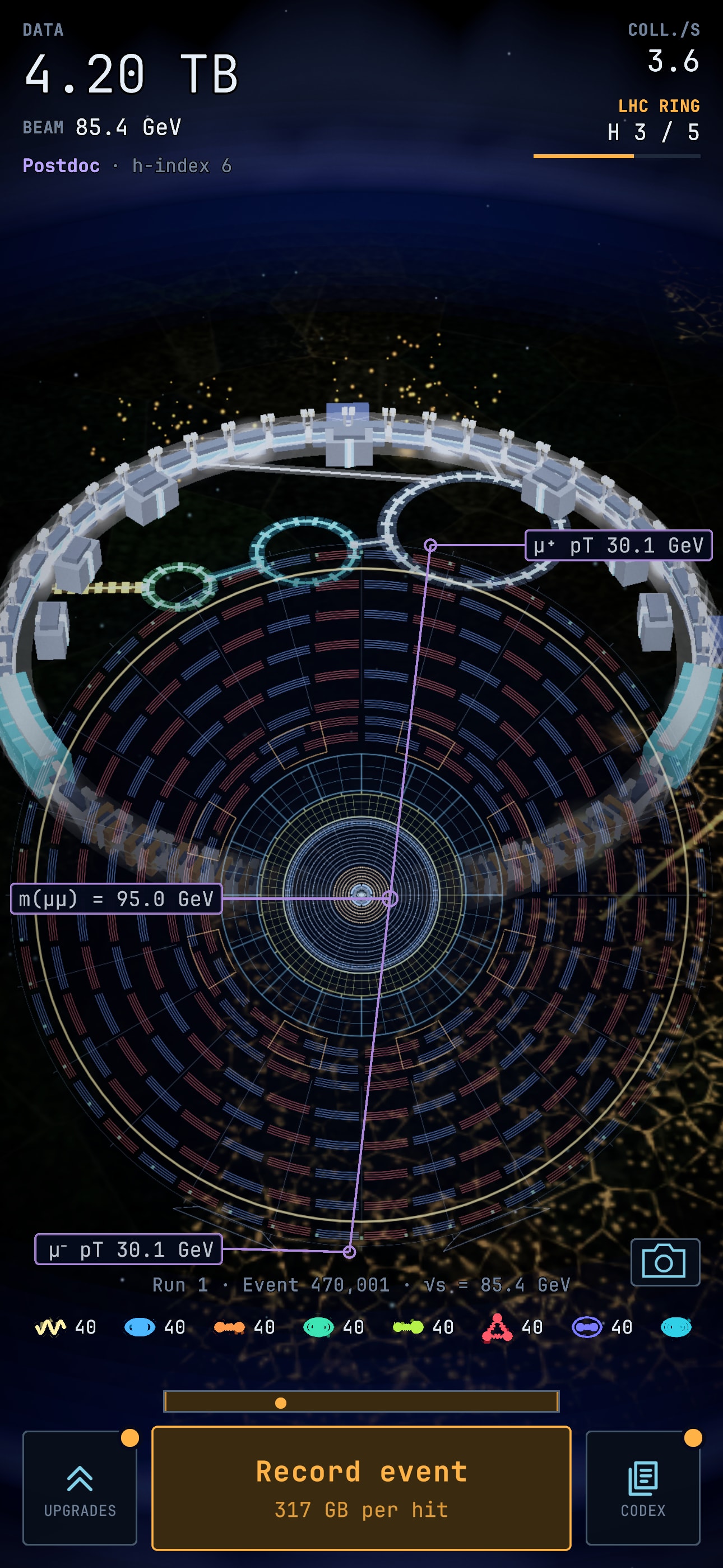
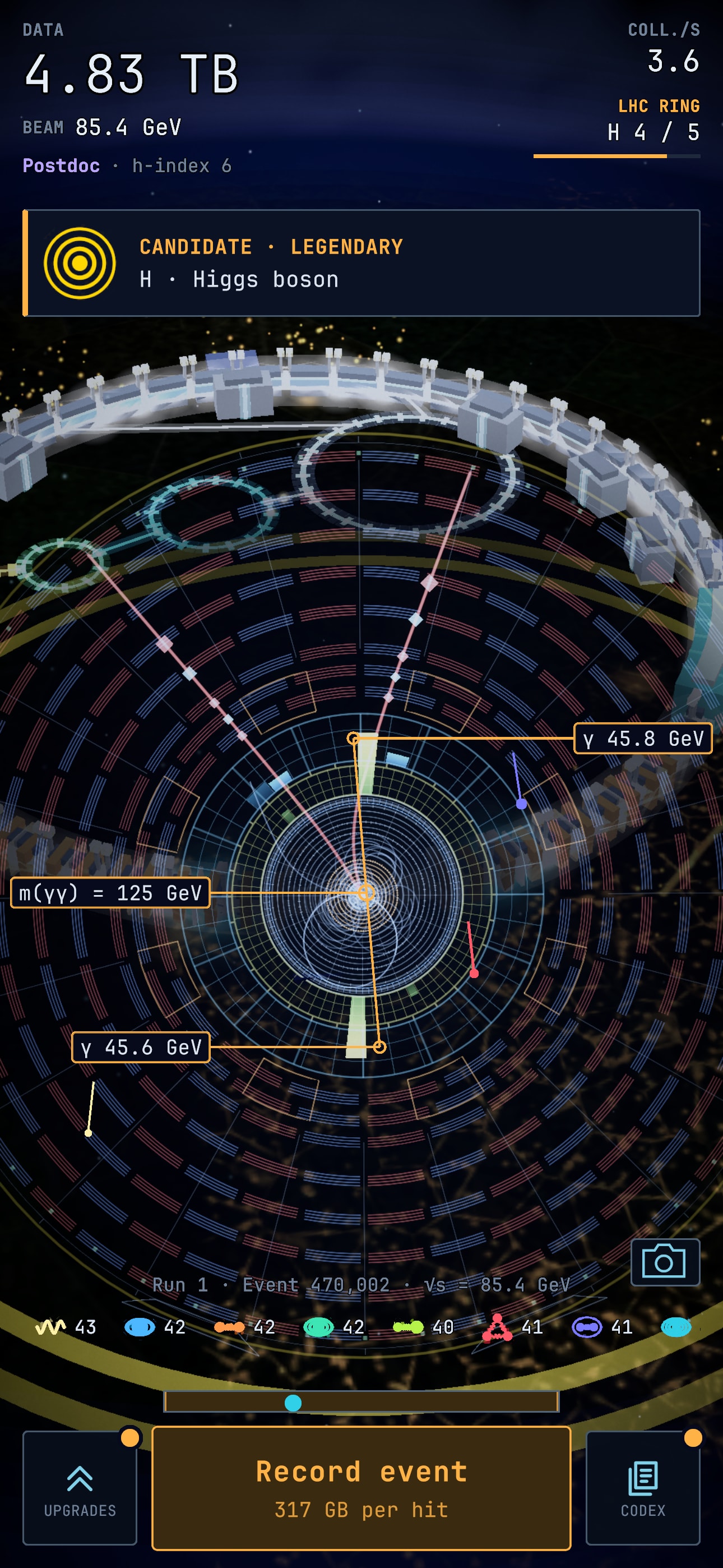
- Collisions appear as event displays in a detector cross-section: tracks, calorimeter towers, missing energy.
- Real particles carry Particle Data Group masses; hypothetical particles and fictional rings are labelled as such.
- Seven rings in true scale, with the previous ring shown at its real size and place inside the next one.
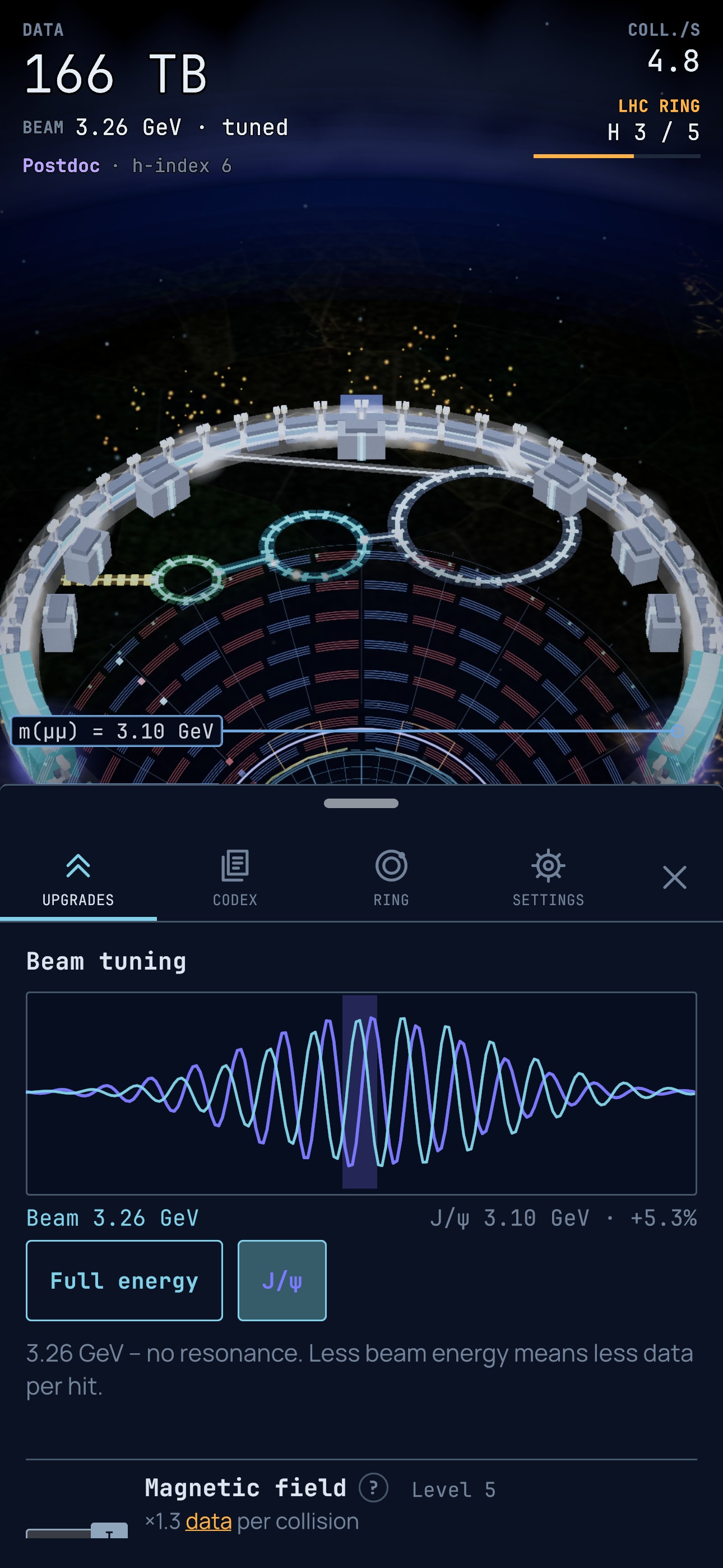
- Resonance tuning that you can feel through haptics, like a Geiger counter closing in on a signal.
- Free at the LHC with all 13 real particles, one one-time purchase for the rest, nothing else to buy.
How it was made
Idea, game design, the choice of physics and every decision are the developer’s own. The code was written with Claude Code. The graphics are not AI images: worlds, detector, icons and Professor Quark are drawn by program code, and the Earth maps come from NASA and Natural Earth. The music was made with Suno, the sound effects with ElevenLabs. The translations into the other seven languages are machine-made and not yet checked by native speakers; corrections are welcome. Particle masses are Particle Data Group values.
Download
The ZIP contains the app icon, three key-art images, eight screenshots each in English and German (without marketing text) and the fact sheet as text.
↓ Press kit (ZIP, about 10 MB)↓ App icon (PNG, 1024 × 1024)
The images may be used for editorial coverage of the game.
Key art
Screenshots
Contact
Write to info (at) idlecollider (dot) com, in English or German. Interviews, further images and video material on request.
Idle Collider is an independent project and is not affiliated with CERN.
Pressematerial
Faktenblatt, Beschreibungen und Bilder für redaktionelle Berichte.
In einem Absatz
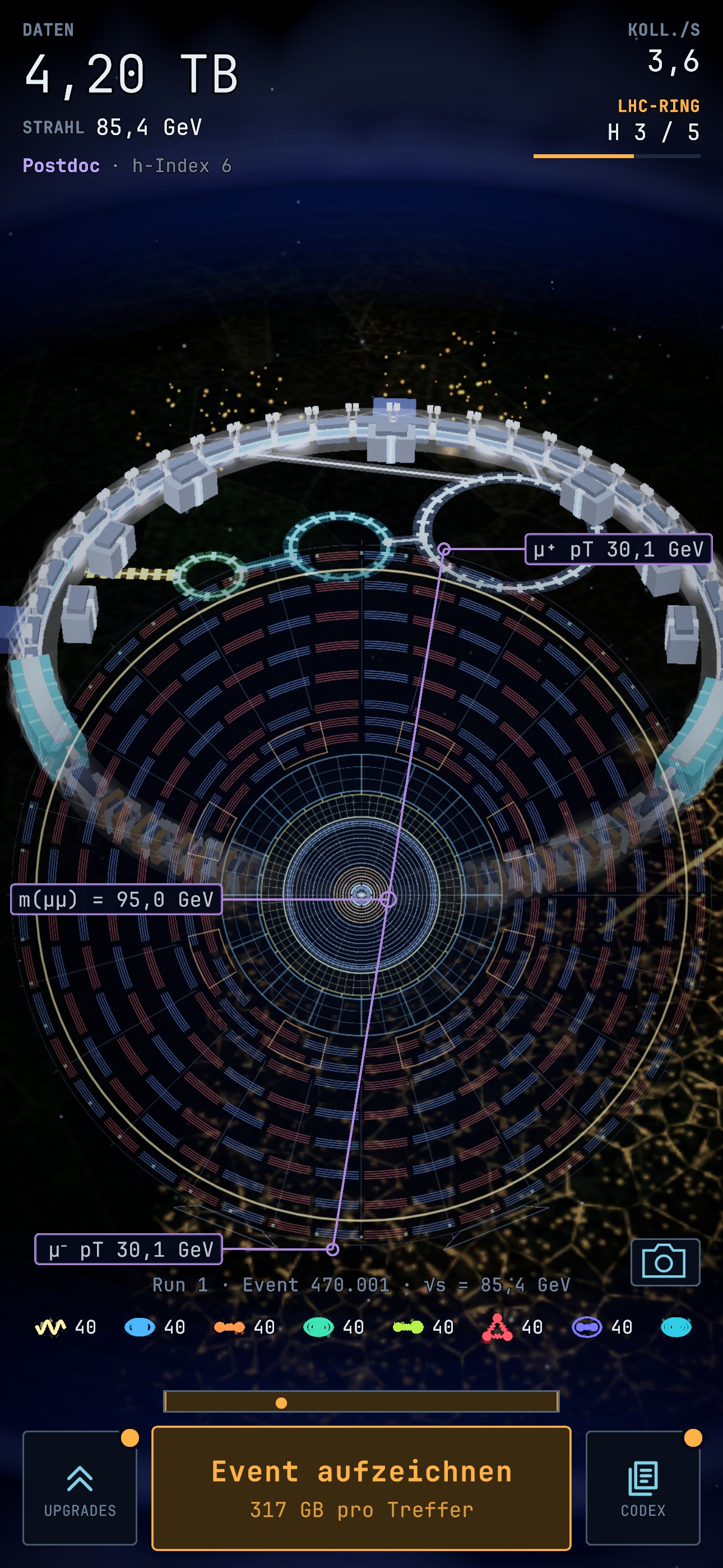
Idle Collider: Higgs Hunt ist ein Incremental-Spiel über echte Teilchenphysik für das iPhone. Man betreibt einen Teilchenbeschleuniger, trifft den Takt der Paketkreuzungen und sammelt 26 Teilchen, vom Photon bis zum Higgs-Boson. Jede Kollision erscheint als Event-Display, so wie Physiker sie sehen. Der LHC-Ring ist kostenlos spielbar, ohne Werbung.
Faktenblatt
- Titel
- Idle Collider: Higgs Hunt
- Genre
- Incremental-/Idle-Spiel, Teilchenphysik
- Plattform
- iPhone (App Store). Android ist für später geplant.
- Start
- Oktober 2026
- Preis
- Kostenloser Download. Ring 1 (LHC) ist frei und unbegrenzt spielbar. Ein optionaler Einmalkauf (3,99 €) schaltet die Ringe 2–7 frei.
- Geschäftsmodell
- Keine Werbung, keine Abos, kein Konto, keine Datenerhebung. Teilchen sind nie käuflich.
- Sprachen
- Englisch, Deutsch, Chinesisch (vereinfacht), Japanisch, Koreanisch, Spanisch, Französisch, Portugiesisch (Brasilien), Italienisch
- Entwickler
- Nicolai Emig, Einzelentwickler, Deutschland
- Website
- idlecollider.com
- App Store
- apps.apple.com/app/id6819080461
Beschreibung
Man betreibt einen Teilchenbeschleuniger. Wer im Takt der Paketkreuzungen tippt, erzeugt Kollisionen und macht aus den Daten und den gefundenen Teilchen stärkere Magnete, bessere Detektoren und größere Ringe. Nach etwa einer Minute kollidiert die Maschine von selbst weiter, auch wenn die App geschlossen ist.
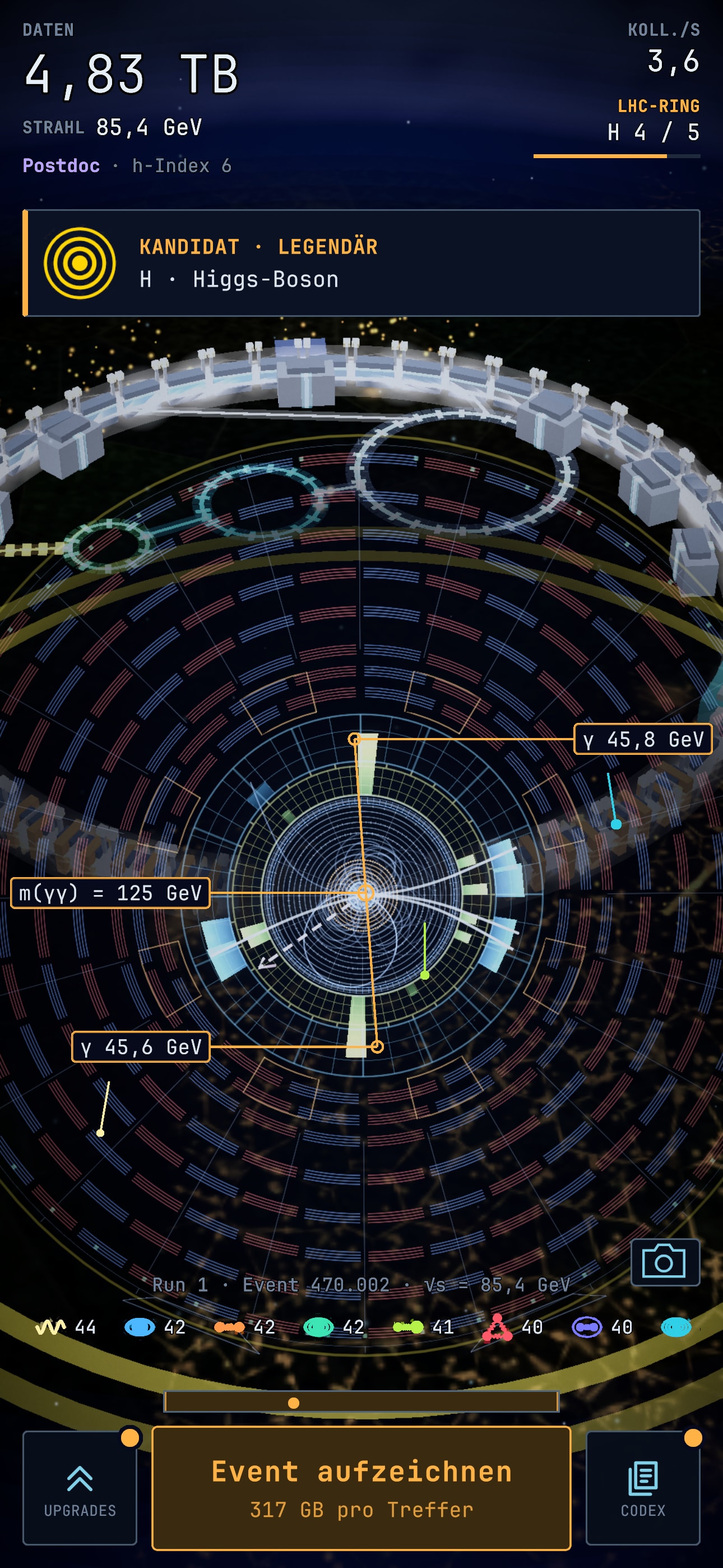
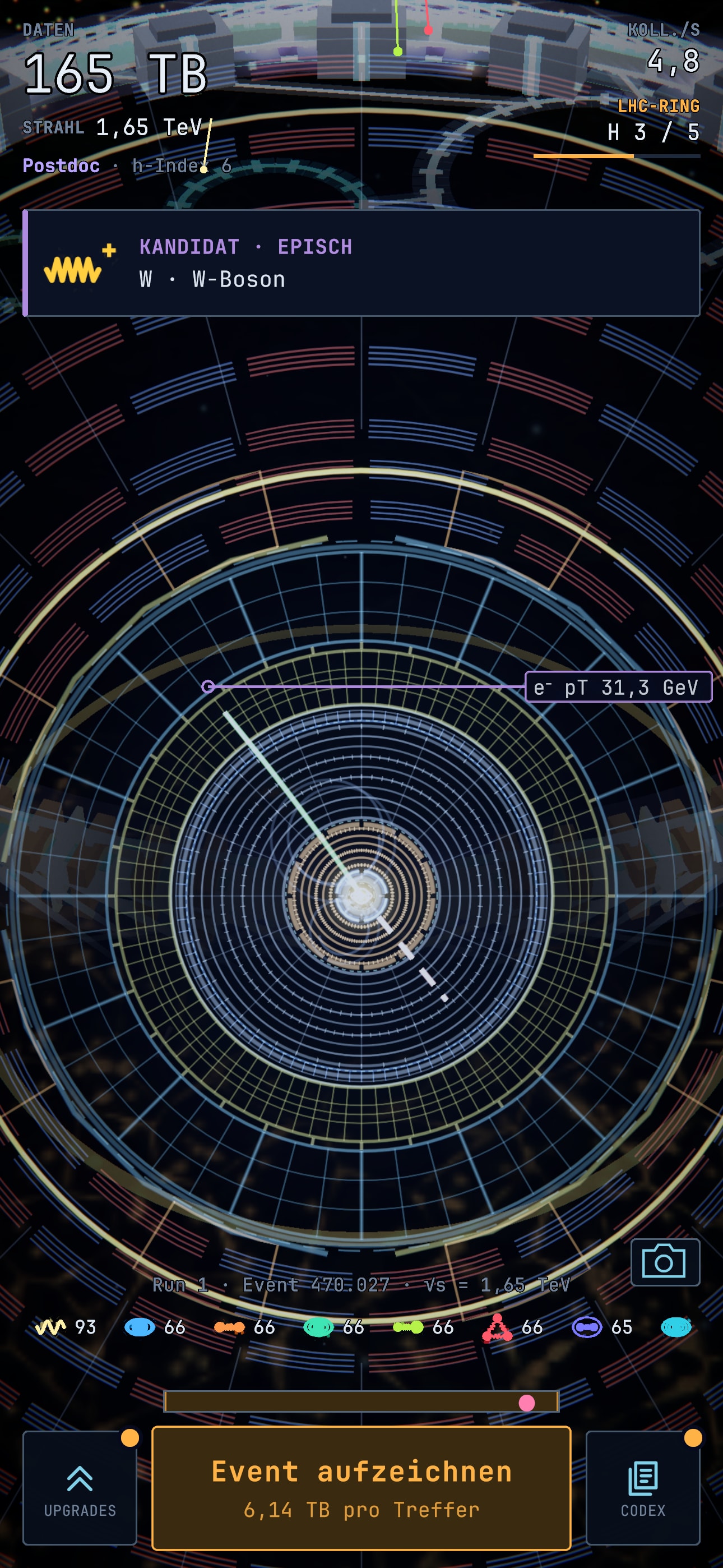
Der Codex umfasst 26 Teilchen: 13 echte aus dem Standardmodell, vom Photon bis zum Top-Quark, jedes mit einem nachprüfbaren Fakt, und 13 hypothetische wie das Axion, den magnetischen Monopol oder das WIMP. Alles, was nur Theorie ist, ist als hypothetisch gekennzeichnet. Professor Quark, ein Pixel-Physiker mit trockenem Humor, erklärt, was zu sehen ist.
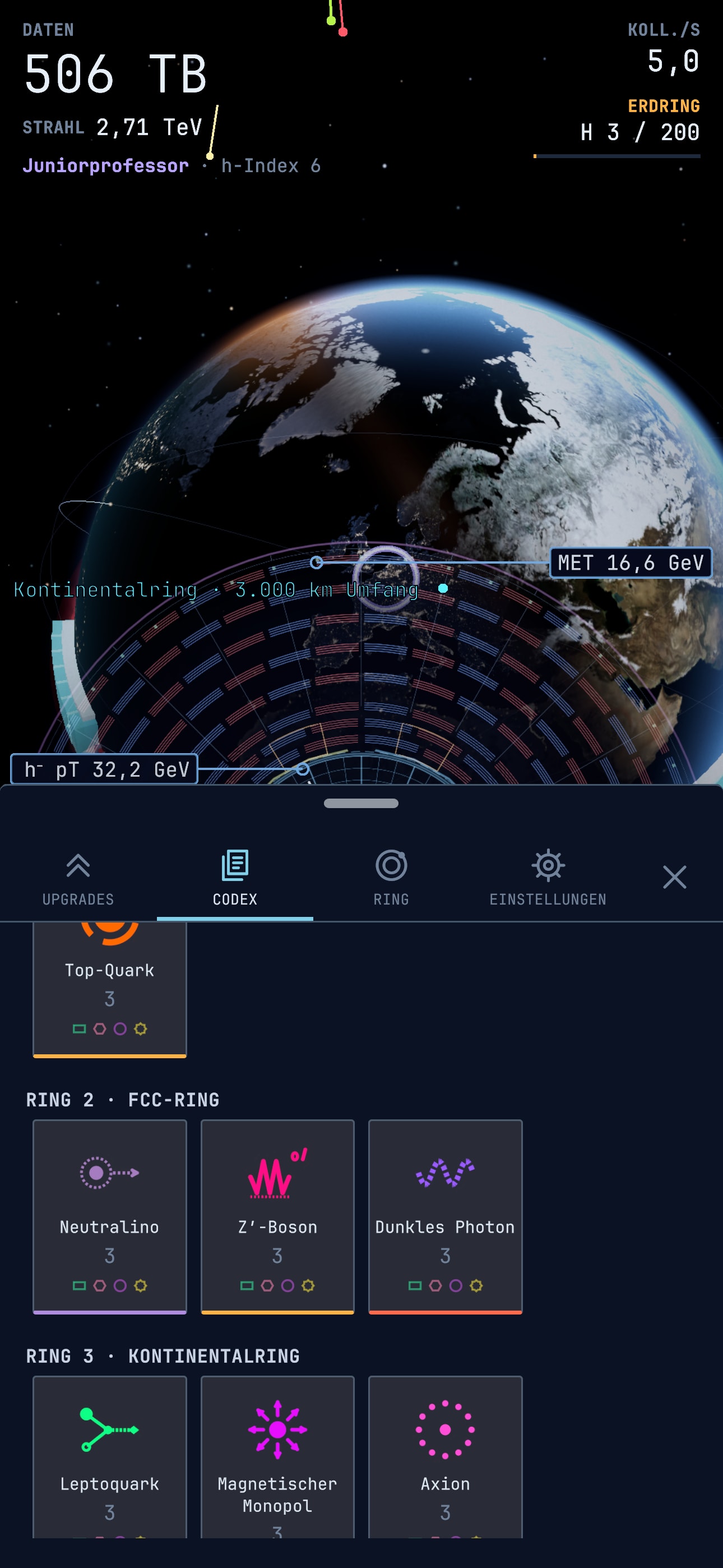
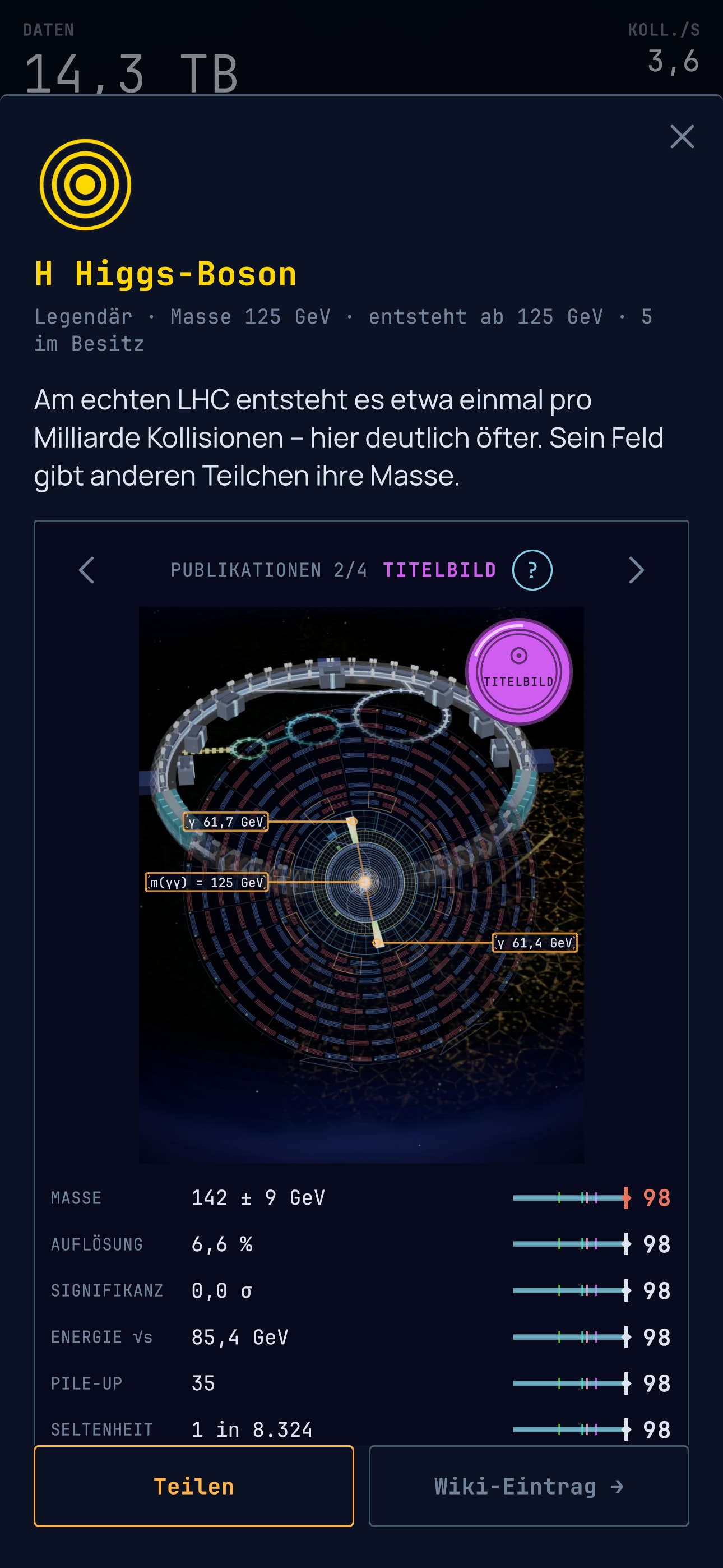
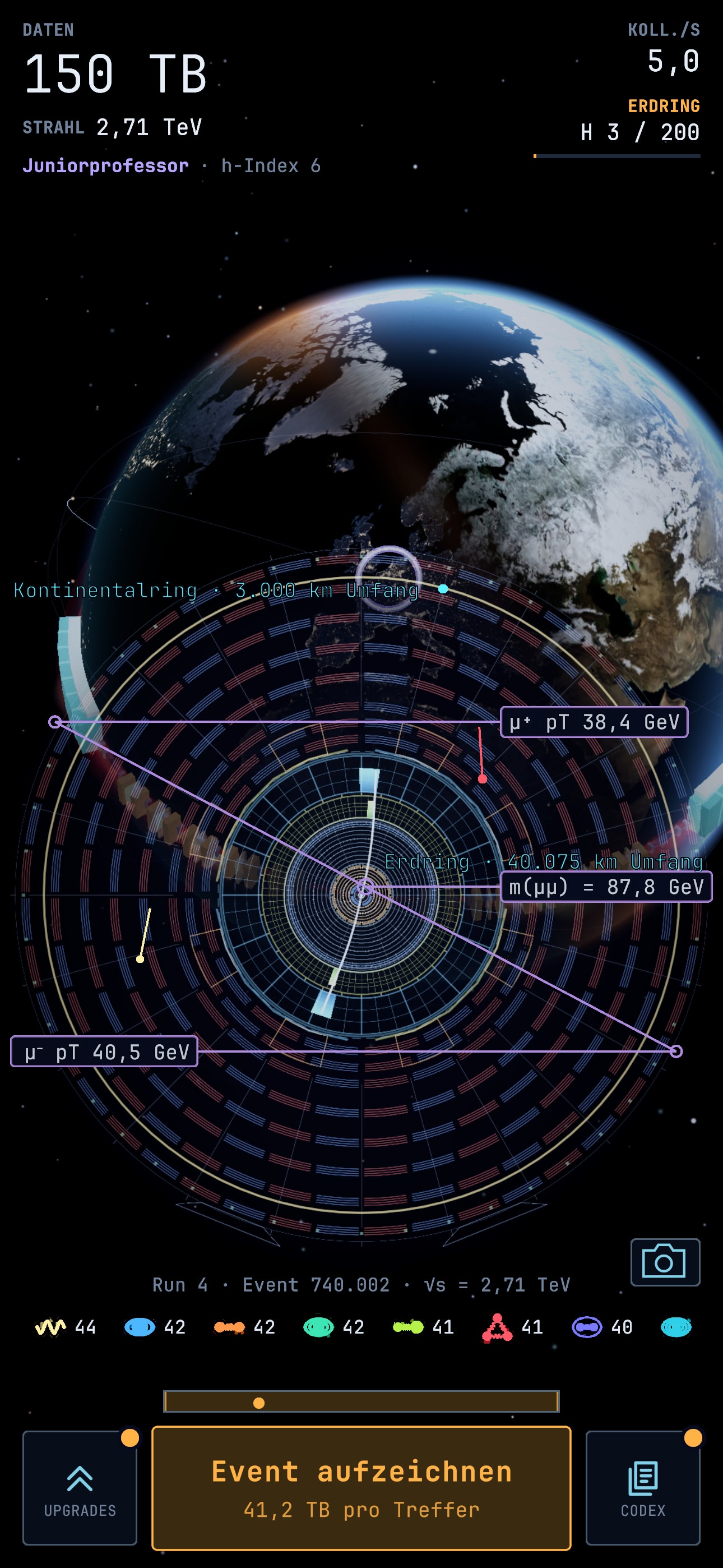
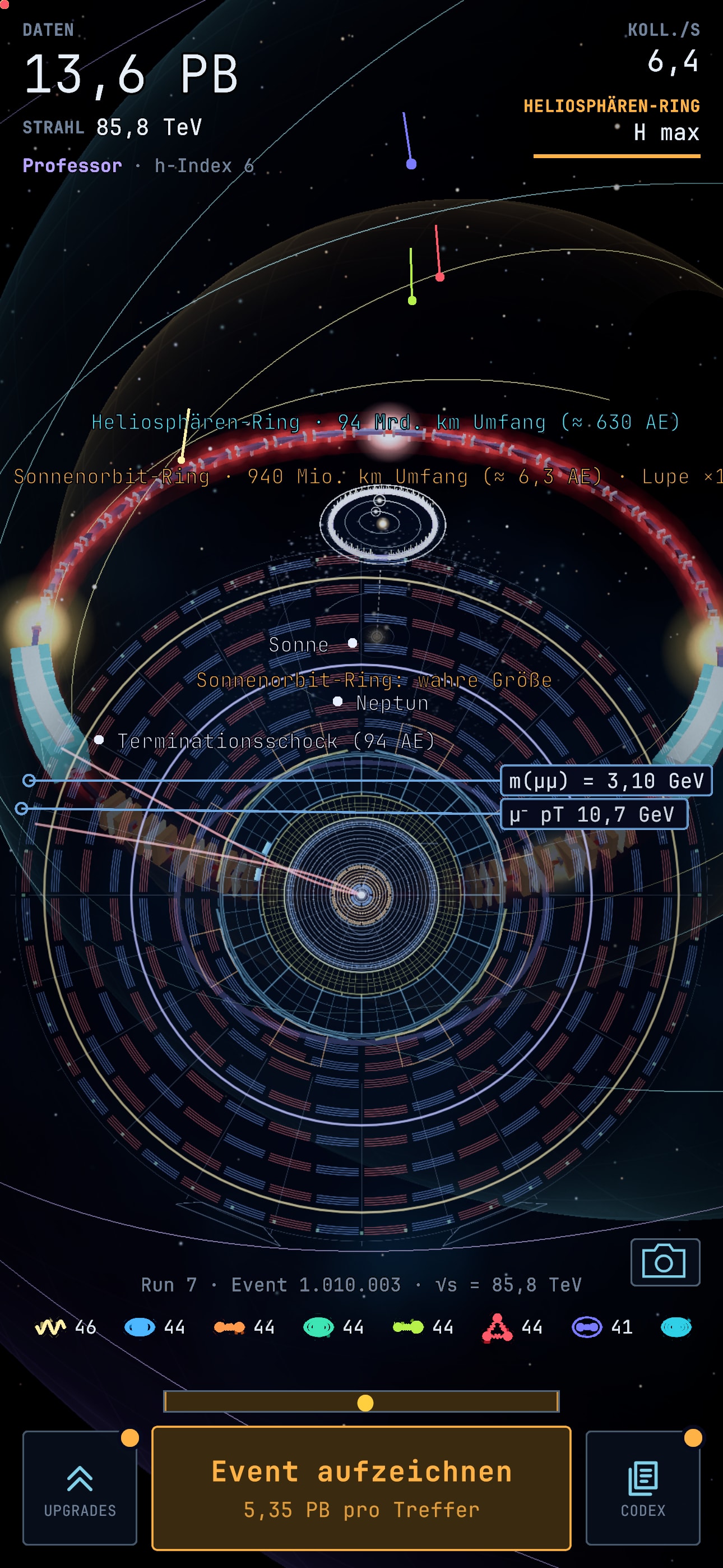
Sieben Ringe sind im wahren Maßstab gezeichnet: der 27 km lange LHC, der geplante FCC und fiktive Ringe um einen Kontinent, um die Erde, entlang der Mondbahn und um die Sonne, bis hinaus zur Heliosphäre. Jedes aufgezeichnete Ereignis erhält sieben Messwerte und ein Urteil von Rohdaten bis Nobelpreis, die besten werden zu Postern zum Teilen. Daneben läuft eine Forschungskarriere mit Publikationen, Zitationen und h-Index.
Was das Spiel besonders macht
- Kollisionen erscheinen als Event-Displays im Detektorquerschnitt: Spuren, Kalorimeter-Türme, fehlende Energie.
- Echte Teilchen tragen die Massen der Particle Data Group; hypothetische Teilchen und fiktive Ringe sind als solche gekennzeichnet.
- Sieben Ringe im wahren Maßstab; der vorige Ring liegt in echter Größe und Lage im nächsten.
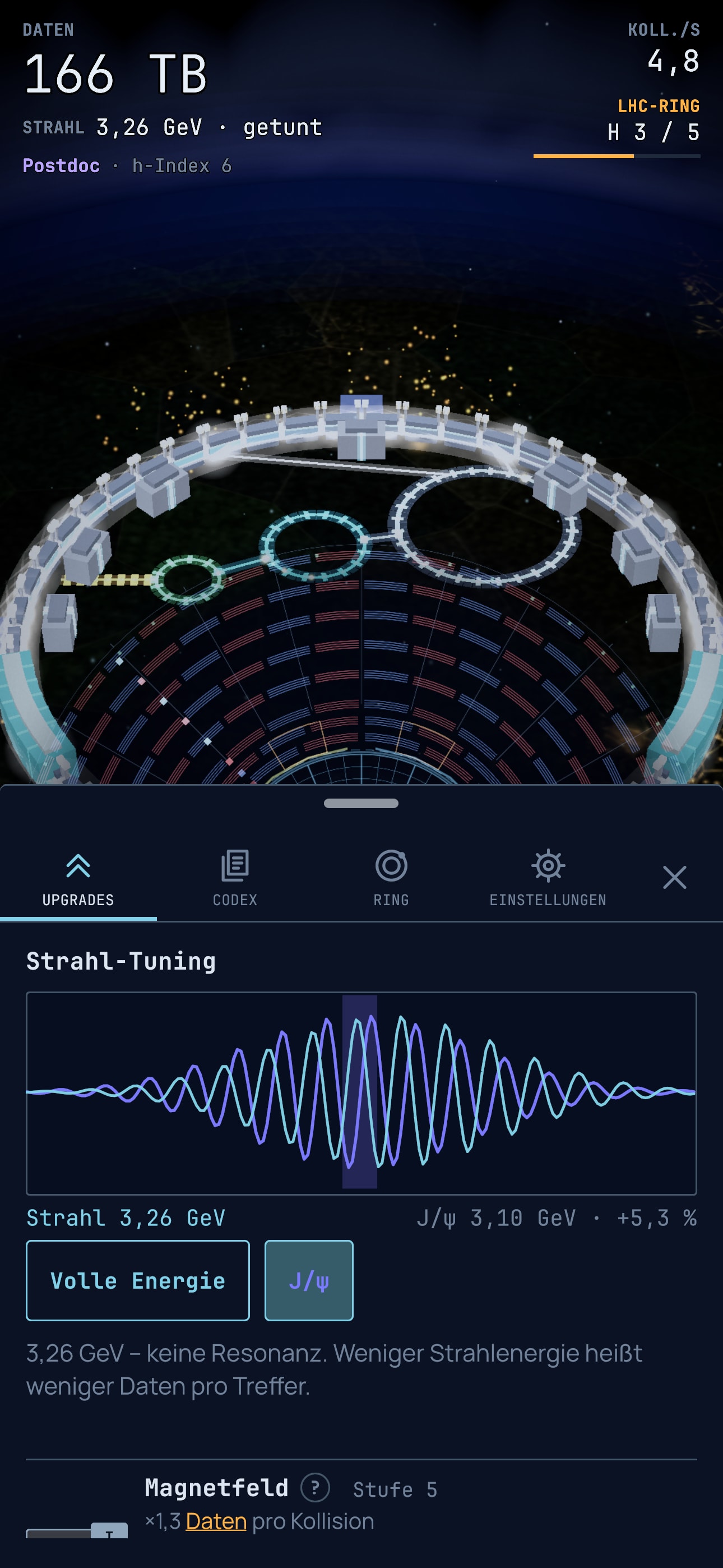
- Resonanz-Tuning, das man über die Haptik spürt, wie ein Geigerzähler, der sich einem Signal nähert.
- Am LHC mit allen 13 echten Teilchen kostenlos, ein Einmalkauf für den Rest, sonst nichts zu kaufen.
Entstehung
Idee, Spieldesign, Physik-Auswahl und alle Entscheidungen stammen vom Entwickler. Der Code ist mit Claude Code geschrieben. Die Grafik ist keine Bild-KI: Welten, Detektor, Icons und Professor Quark werden von Programmcode gezeichnet, die Erdkarten stammen von NASA und Natural Earth. Die Musik ist mit Suno entstanden, die Soundeffekte mit ElevenLabs. Die Übersetzungen in die übrigen sieben Sprachen sind maschinell erstellt und noch nicht von Muttersprachlern geprüft; Korrekturen sind willkommen. Die Teilchenmassen sind Werte der Particle Data Group.
Download
Das ZIP enthält das App-Icon, drei Key-Art-Bilder, je acht Screenshots auf Deutsch und Englisch (ohne Werbetext) und das Faktenblatt als Text.
↓ Pressepaket (ZIP, etwa 10 MB)↓ App-Icon (PNG, 1024 × 1024)
Die Bilder dürfen für redaktionelle Berichte über das Spiel verwendet werden.
Key-Art
Screenshots
Kontakt
Schreiben Sie an info (at) idlecollider (dot) com, auf Deutsch oder Englisch. Interviews, weitere Bilder und Videomaterial auf Anfrage.
Idle Collider ist ein unabhängiges Projekt ohne Verbindung zum CERN.