Idle ColliderHiggs Hunt
with Professor Quark
Hunt the Higgs.
An idle particle accelerator on real physics. Fire the beam in rhythm, discover 26 particles and grow the LHC out to the edge of the solar system.
A particle accelerator you play with your thumb
Fire in rhythm
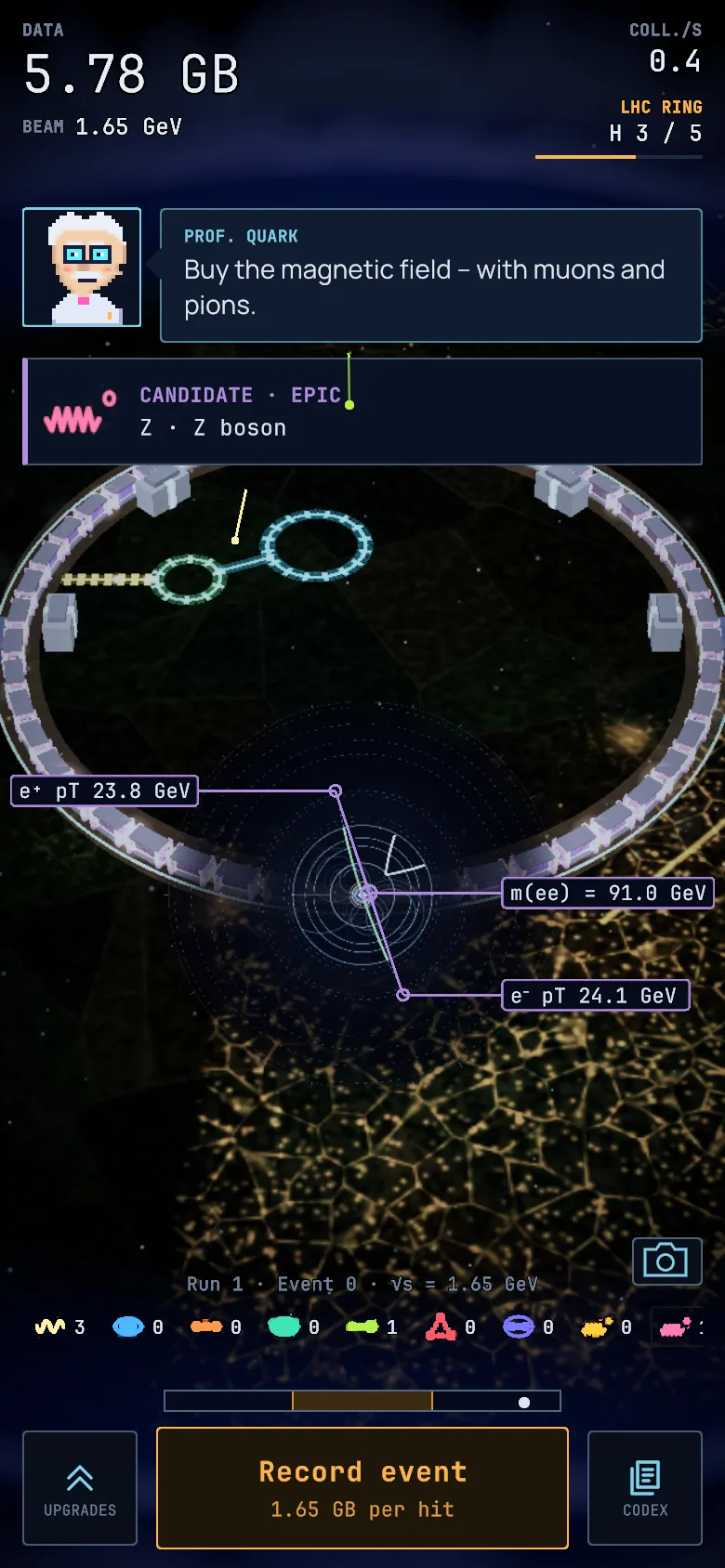
Four bunches per beam cross the detector on a steady beat. Tap inside the bright window for a hit; tap beside it and you only hit residual gas.
Collect 26 particles
From the photon to the top quark, plus hypothetical candidates that physicists are still searching for. Every particle gets a codex entry with a fact.
Build the detector like an onion
Vertex detector, tracker, calorimeter and muon chambers each boost a family of particles and visibly grow around the collision point.
Expand the ring
Seven rings: the 27 km LHC, the FCC, a continental ring, then Earth, Moon and Sun orbits out to the heliosphere.
Publish your events
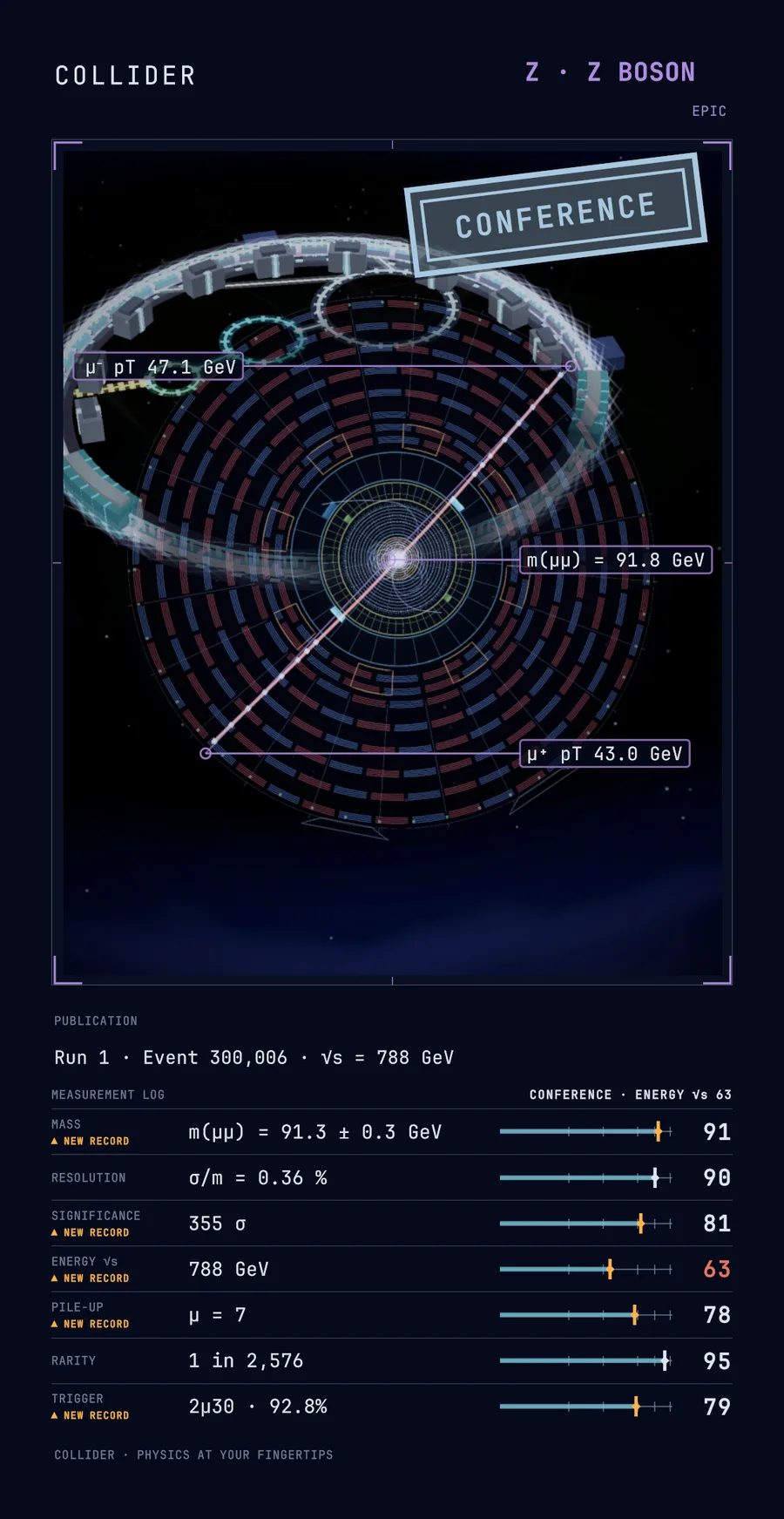
Every event is measured with seven values. The weakest one decides the verdict, from raw data to Nobel prize. Share your best as a poster.
Keeps running while you are away
Luminosity automates collisions and the cryostat extends offline operation. Come back to a summary of what the beam found.
Inside the control room
The collision
Fire in rhythm with the bunches. The event display labels every track.
The codex
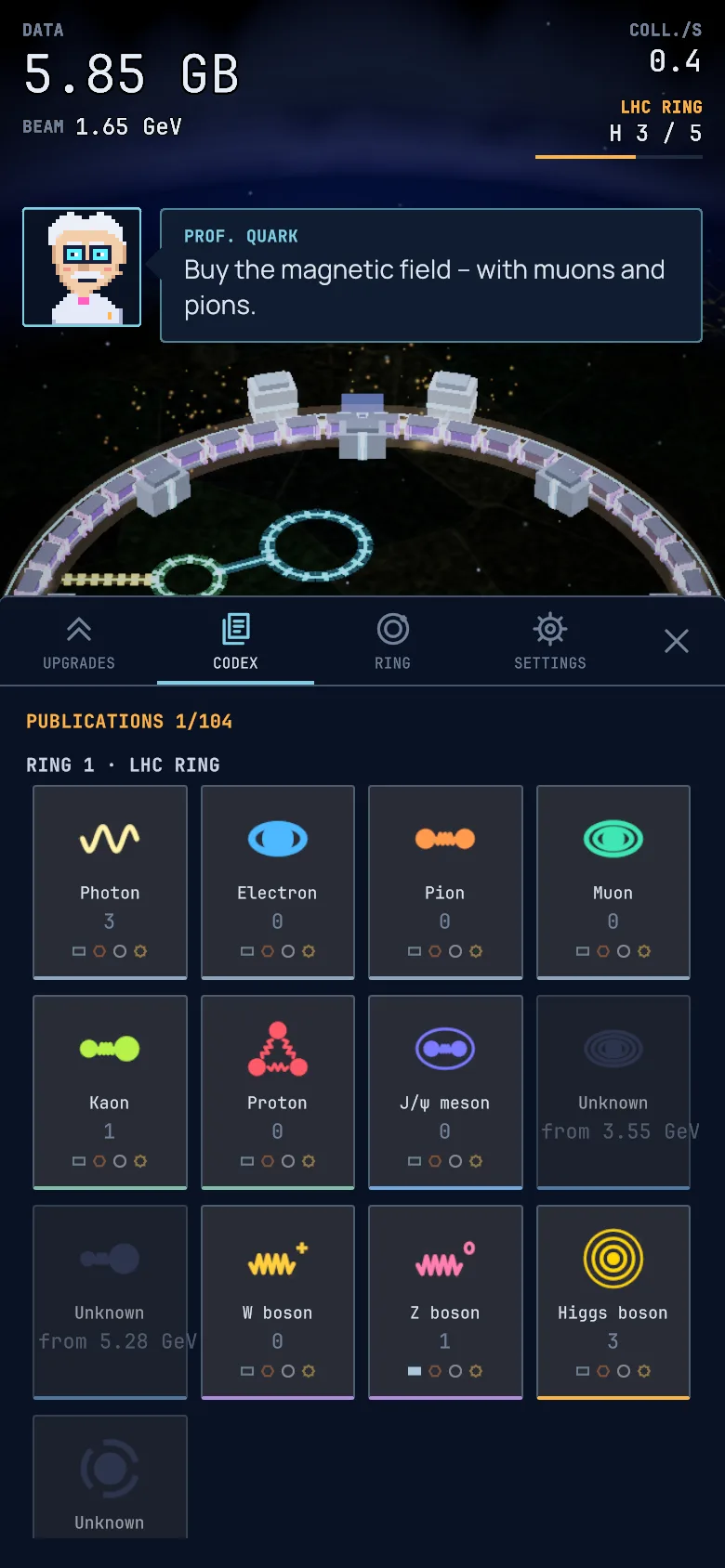
26 particles, grouped by the ring where they first appear.
Publication posters
Seven measured values and a verdict, ready to share.
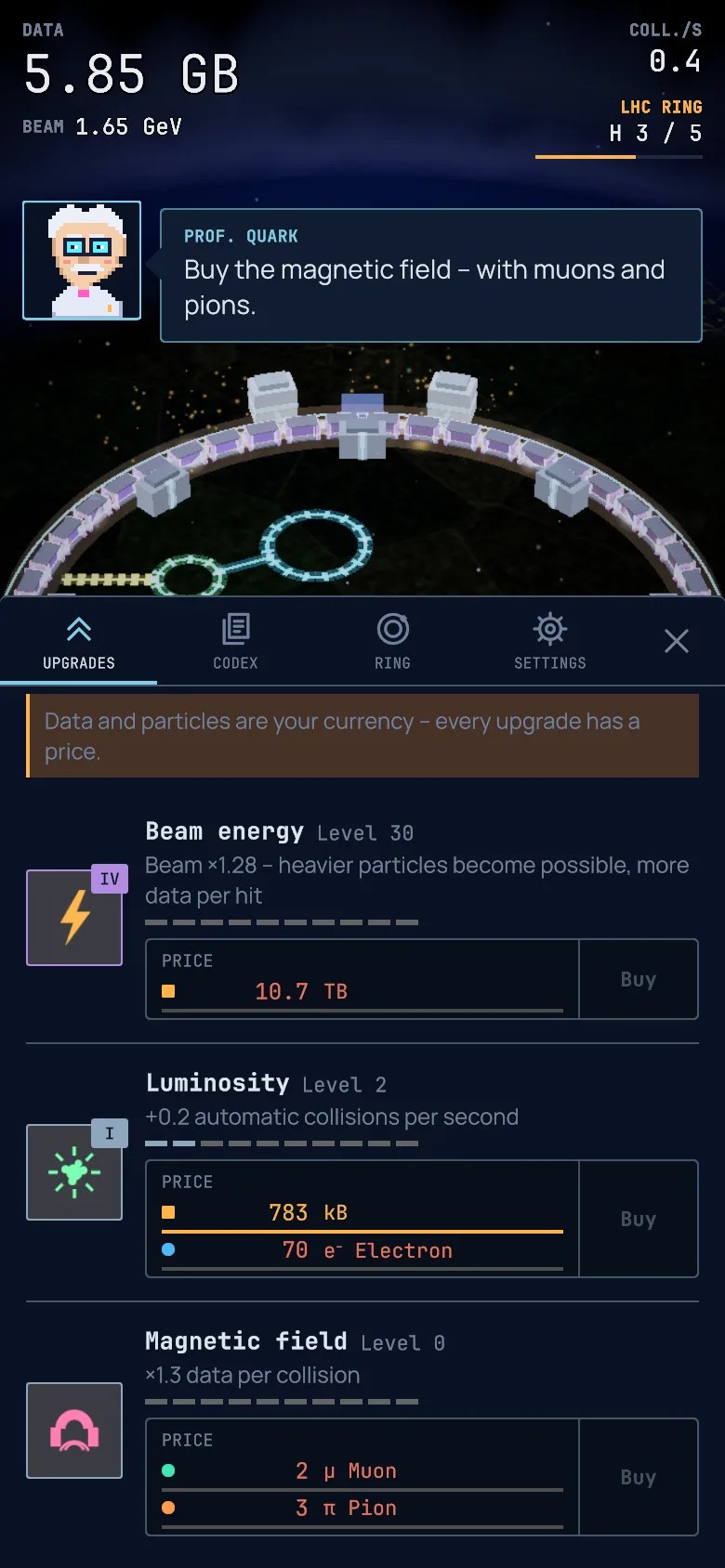
Upgrades
Beam, magnets, detectors and focus, each paid in its own particles.
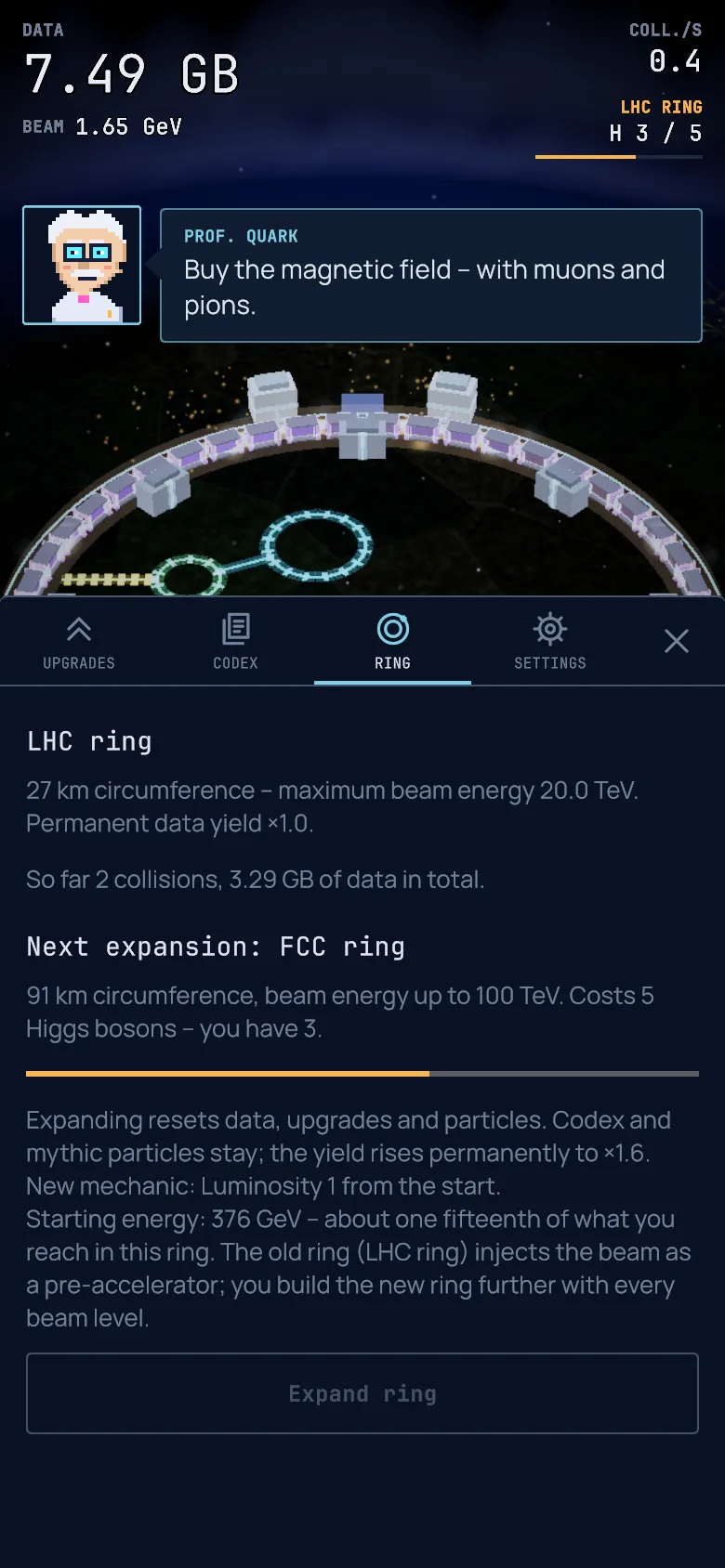
The ring
Collect Higgs bosons and expand to the next ring.
Real physics, clearly labelled
Names, masses and the order of rarity follow the Particle Data Group tables. Rates are compressed so that you can watch things happen: the real LHC makes a Higgs boson about once per billion collisions, here it comes far more often. Whatever the game invents is marked as such.
Real
13 particles of the Standard Model, observed in experiments, with their real names, symbols and masses.
Hypothetical
13 candidates from theory that have never been detected, such as the dark photon, the axion and the graviton. They appear from ring 2 on, always carry the hypothetical label, and their game thresholds are fictional.
Future fiction
Ring 1 is the real LHC and ring 2 follows a real CERN study, the FCC. From ring 3 on the rings are fiction, and the game says so.
- 1LHC ringreal
- 2FCC ringCERN study
- 3Continental ringfiction
- 4Earth ringfiction
- 5Lunar orbit ringfiction
- 6Solar orbit ringfiction
- 7Heliosphere ringfiction

Meet Professor Quark
He greets you in the first minute, explains every mechanic when it first matters and has an opinion about every hypothetical particle you find. All of his lectures are in the wiki.
PROF. QUARK
“The principle: two bunches of particles race around the ring in opposite directions, near light speed. They cross inside the detector – there you make them collide. Motion becomes new particles: E = mc².”
Questions
Is the physics real?
Names, symbols, masses and the order of rarity are real (Particle Data Group). Production rates are compressed so that rare things happen within minutes. Hypothetical particles and the rings from ring 3 on are fiction and always labelled that way.
Do I need an account or an internet connection?
No account and no ads. Your save game stays on your device. The game is free; one optional purchase unlocks the full version (see below).
Is the game free?
Yes. Rings 1 (LHC) and 2 (FCC) are free, including all 13 real Standard Model particles. One optional one-time purchase, “Full version” (3.99 € or local equivalent), unlocks rings 3–7 and their particles. No ads, no subscriptions; particles and rarities are never for sale and the purchase does not change drop rates.
Which devices are supported?
The first release is for iPhone (iOS). An Android version is planned for later.
Which languages does the game speak?
English, German, Simplified Chinese, Japanese, Korean, Spanish, French, Brazilian Portuguese and Italian. This website and its wiki follow the same nine languages.
What happens while I am away?
With luminosity the beam keeps colliding. When you return, the game adds up to 2 hours of progress plus 2 hours per cryostat level and shows a summary.
Is the game affiliated with CERN?
No. Idle Collider is an independent project. The LHC and the FCC are real CERN facilities and plans that the game uses for education.
Ready to find the Higgs?
Idle Collider: Higgs Hunt is coming to the App Store. Until then, the wiki already knows every particle.