Publications
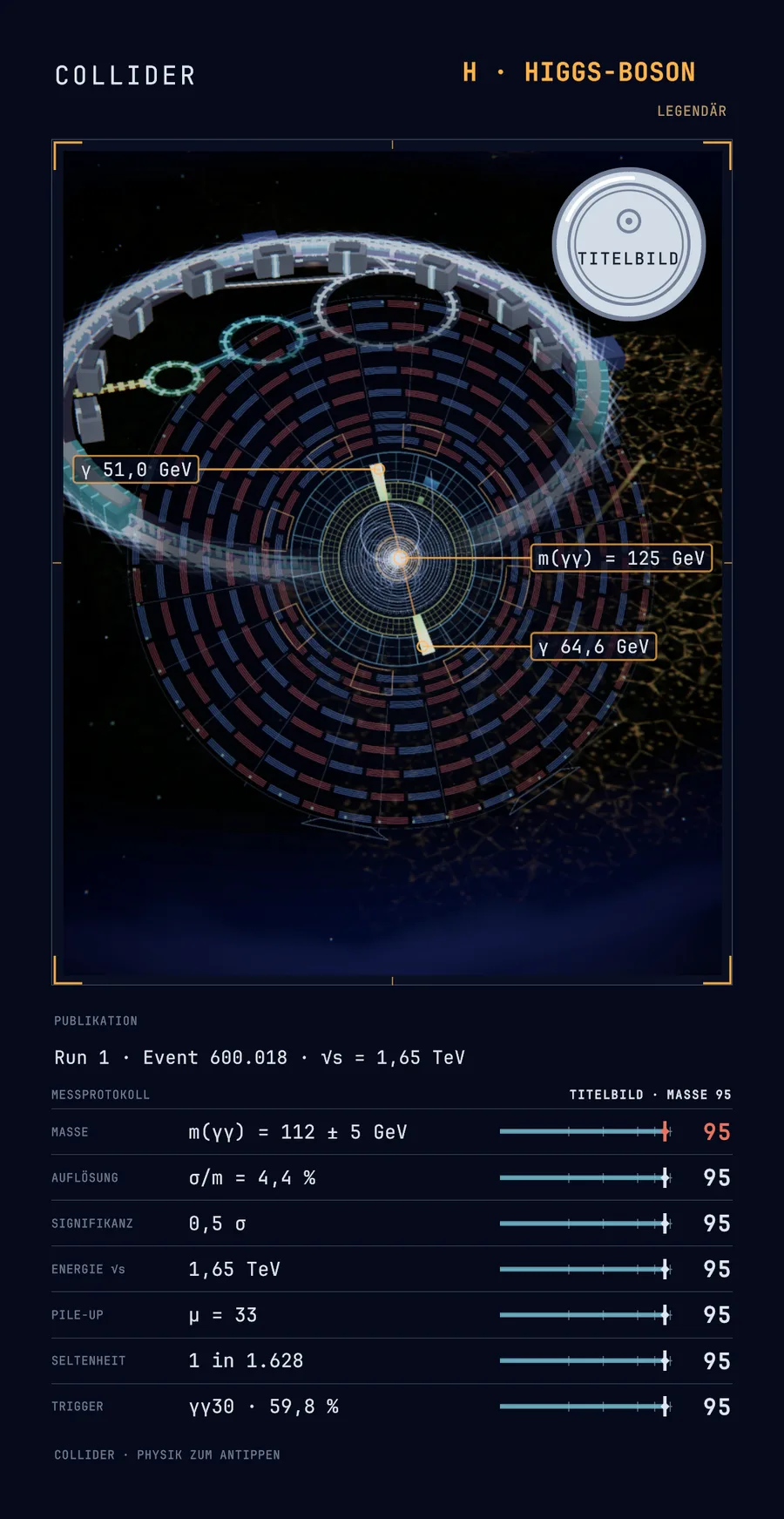
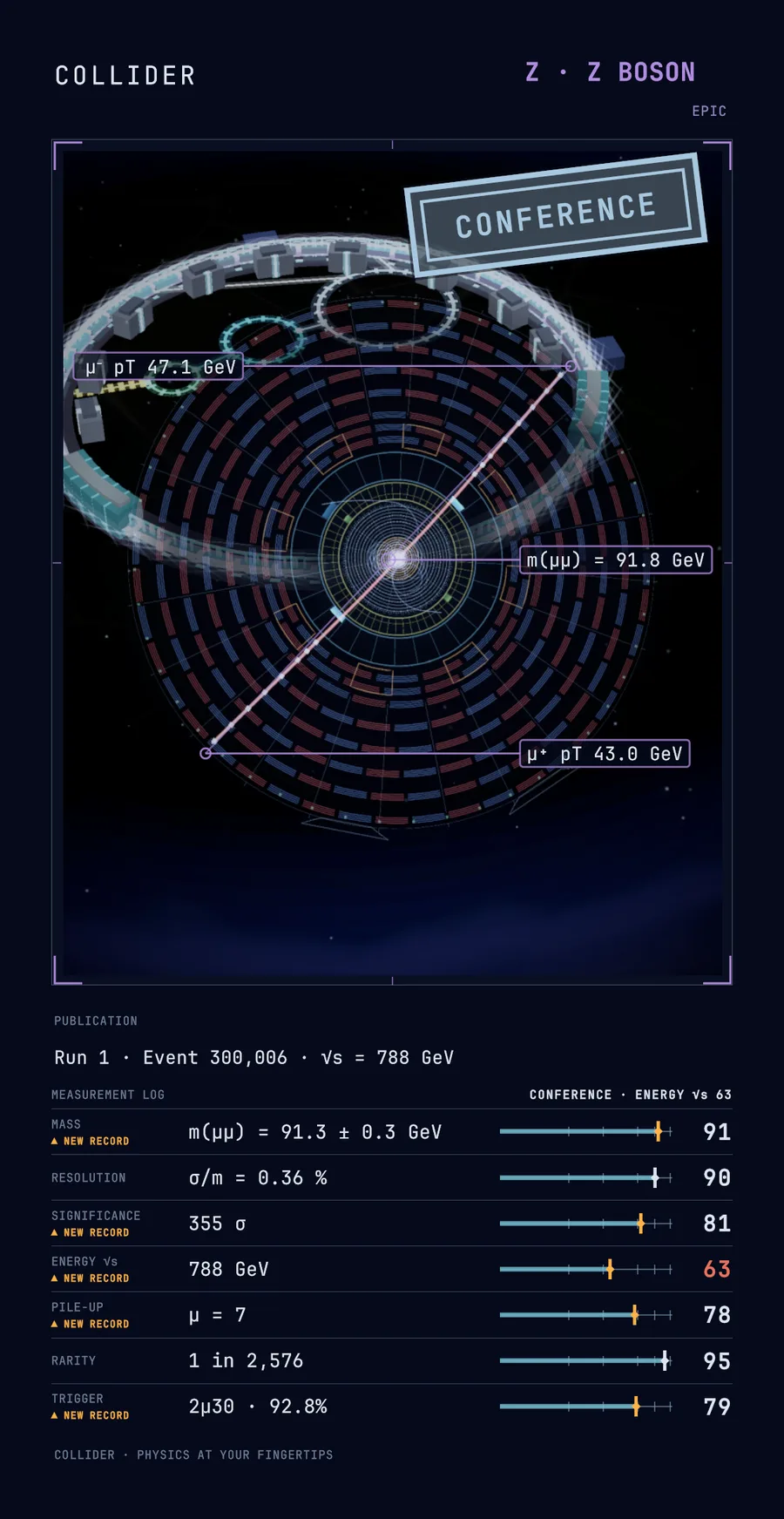
Every recorded event is measured with seven values and compared with a mix of comparison events. The weakest value decides the verdict.
The seven values
PROF. QUARK
“Every event you record is measured with seven values: mass, resolution, significance, √s, pile-up, rarity and trigger. You'll find them in the measurement log.”
MASS
Reconstructed mass
Reconstructed from the decay products (for particles without a resonance the leading quantity, e.g. energy or ΣE_T). What is rated is the total error: the uncertainty plus the deviation from the true value. Smaller is better.
RESOLUTION
Mass resolution
How sharply the detector measures the quantity, σ/m. Calorimeter: a/√E ⊕ b, tracker: c·pT ⊕ d. Smaller is better.
SIGNIFICANCE
Significance
Signal against background in the mass window, in standard deviations. From 5 σ, a finding counts as a discovery in particle physics. Larger is better.
ENERGY √s
Centre-of-mass energy √s
Energy of the collision in the centre-of-mass frame, here relative to the particle's threshold. The further above it, the more room for the decay products. Larger is better.
PILE-UP
Pile-up
This many collisions overlap in the same bunch crossing and smear the interesting event. Fewer is cleaner.
RARITY
Rarity
On average this many collisions are needed for this particle (the real drop rate, without the detection boost of the sub-detectors). The find came with a bit more or less luck. Larger is better.
TRIGGER
Trigger efficiency
The trigger decides within microseconds whether an event is kept. The efficiency tells which fraction of such events gets through. Larger is better.
Percentiles
“Better than 60 %” means better than 60 out of 100 comparison events. The comparison group is a mix: 60 % of the events come from the same phase of the game (similar beam level), 40 % from all phases. A fresh detector therefore starts modestly, and every upgrade makes the same catch count for more.
PROF. QUARK
“Each value is compared with a mix of comparable events: 60% from your phase of the game, 40% from all phases. So early on, even a good catch ranks modestly – it climbs with your upgrades. “Better than 60%” means: better than 60 out of 100 comparison events.”
The minimum rule
Of the seven percentiles only the weakest counts. One weak value holds everything back, so a clean publication needs a balanced detector.
PROF. QUARK
“The weakest of the seven values decides: conference, paper, cover story, Nobel prize – each tier needs a better weakest value than the one before, and the bar rises as you progress. One weak value holds back the whole event.”
Verdicts
- RAW DATAbelow 40 %
- NOTEfrom 40 %
- CONFERENCEfrom 60 %
- PAPER64 % → 82 %
- COVER STORY72 % → 92 %
- NOBEL PRIZE97 % → 99.4 %
The bars show the thresholds for a fresh detector; the value on the right is where they end up in the late game. Between beam level 55 and 83 the thresholds rise gradually. So the first conference talk comes quickly, a paper takes a while, and the Nobel prize is practically out of reach early on.
Publication slots
Every particle has its own slot for each of the four top verdicts: conference, paper, cover story and Nobel prize. That makes 104 possible publications. Empty slots fill automatically as soon as you record an event that is good enough.
PROF. QUARK
“Cleanly measured. Good events get published, in four tiers: conference, paper, cover story, Nobel prize – every particle has a slot for each tier. Which tier an event reaches depends on its weakest measurement; better detectors and upgrades raise it. The codex shows what is already published.”
- Photon
- Electron
- Pion
- Muon
- Kaon
- Proton
- J/ψ meson
- Tau
- B meson
- W boson
- Z boson
- Higgs boson
- Top quark
- Neutralino
- Z′ boson
- Dark photon
- Leptoquark
- Magnetic monopole
- Axion
- Heavy neutrino
- Graviton
- Sphaleron
- R-hadron
- WIMP
- String ball
- Micro black hole
First find
Besides the four slots, the codex keeps the first event of every particle you discover: the first find. It is the first card in the particle's detail view and shows its full measurement log, however weak the values are. It is never replaced, it is not a publication slot and it does not count towards the publication total. Particles discovered before this feature have no first find.
Citations
Every filled slot is cited on its own, from 1 per hour for a conference talk up to 50 per hour for a Nobel prize, also while you are away. Citations pay for grants and raise your career title.
How to get better
Expand the detector for resolution and trigger, keep pile-up low, and use resonance tuning for particles that can be tuned. Tap a value in the measurement log to see its range and tips.
PROF. QUARK
“Grey slots are still empty; they fill by themselves as soon as an event is good enough. For that, expand detector, resolution and trigger and keep pile-up low – tap a value to see which upgrade helps.”
Share it
Every publication has a poster that you can send with the iOS share sheet. The poster carries the name of the game, an App Store hint and your career title, and the text that goes with it includes the App Store link.