Skip to content
Collider

Rings

Seven rings. Ring 1 is the real LHC, ring 2 follows a real CERN study, and from ring 3 the rings are future fiction.

Rings

RingSizeStart energyEnergy capCostYieldNew mechanicNew particles
1LHC ring27 km circumference–20 TeV–×1–γ … t
2FCC ring91 km circumference375.8 GeV100 TeV5 Higgs×1.6Luminosity 1 from the start
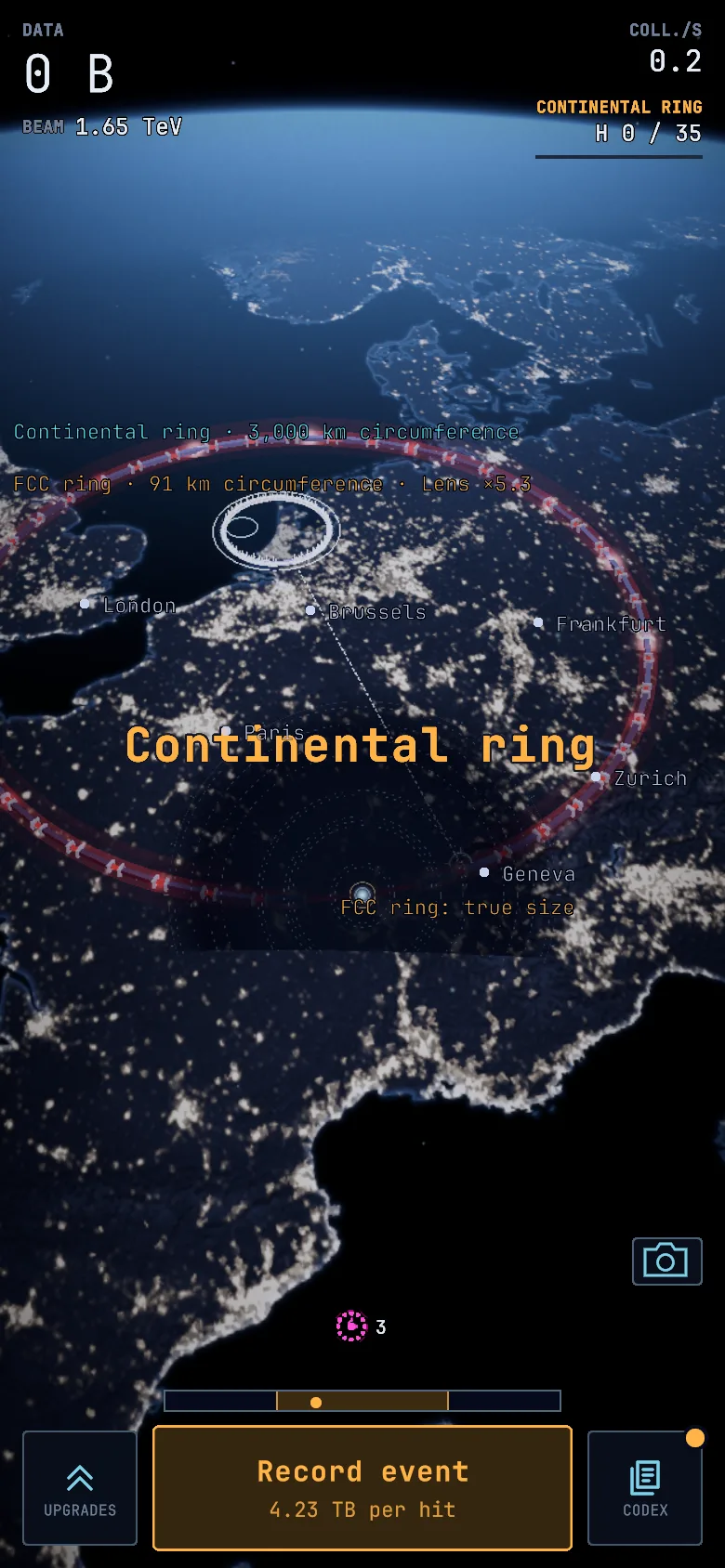
3Continental ring3,000 km circumference1.653 TeV2 PeV12 Higgs×2.6Double beam: every 10th collision counts twice
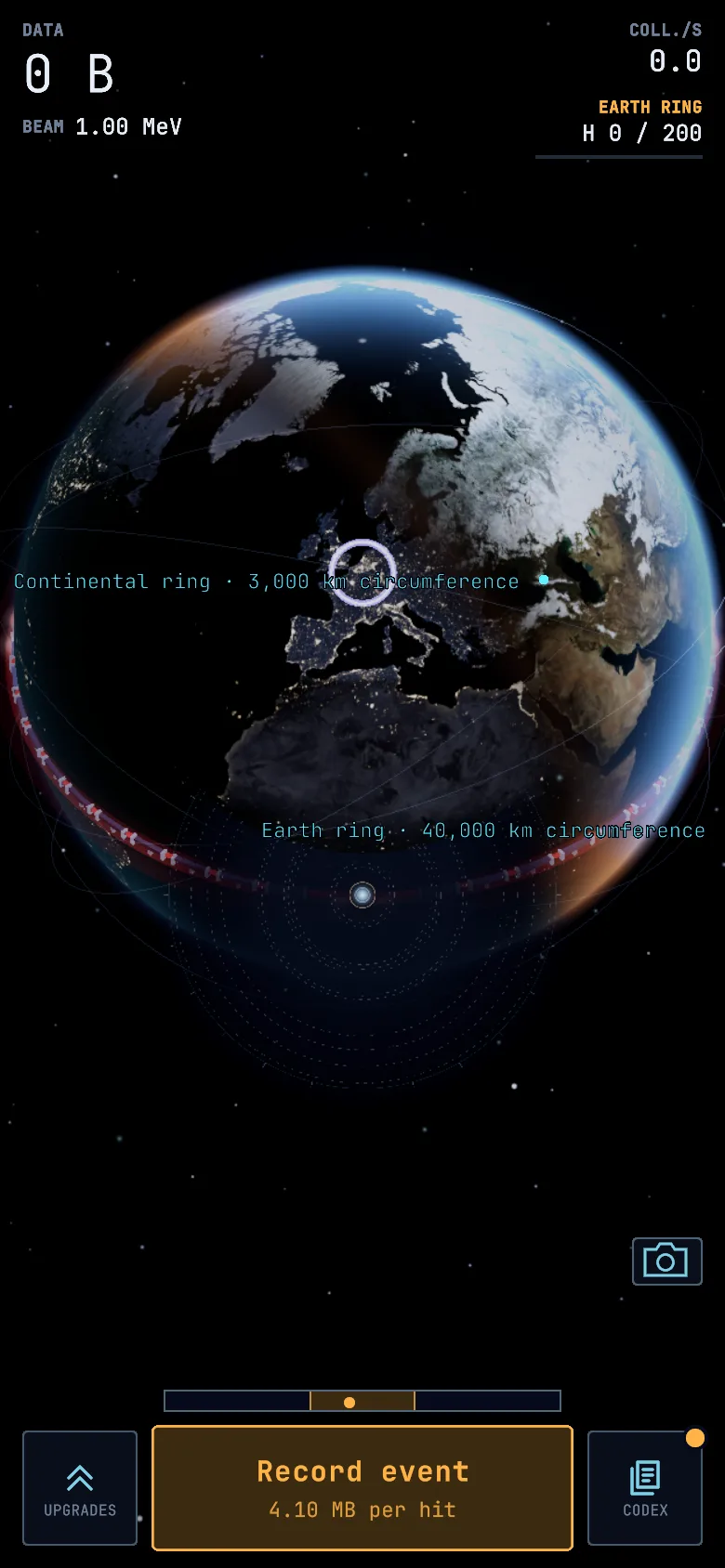
4Earth ring40,000 km circumference24.97 TeV200 PeV35 Higgs×4.1Combo holds during automation
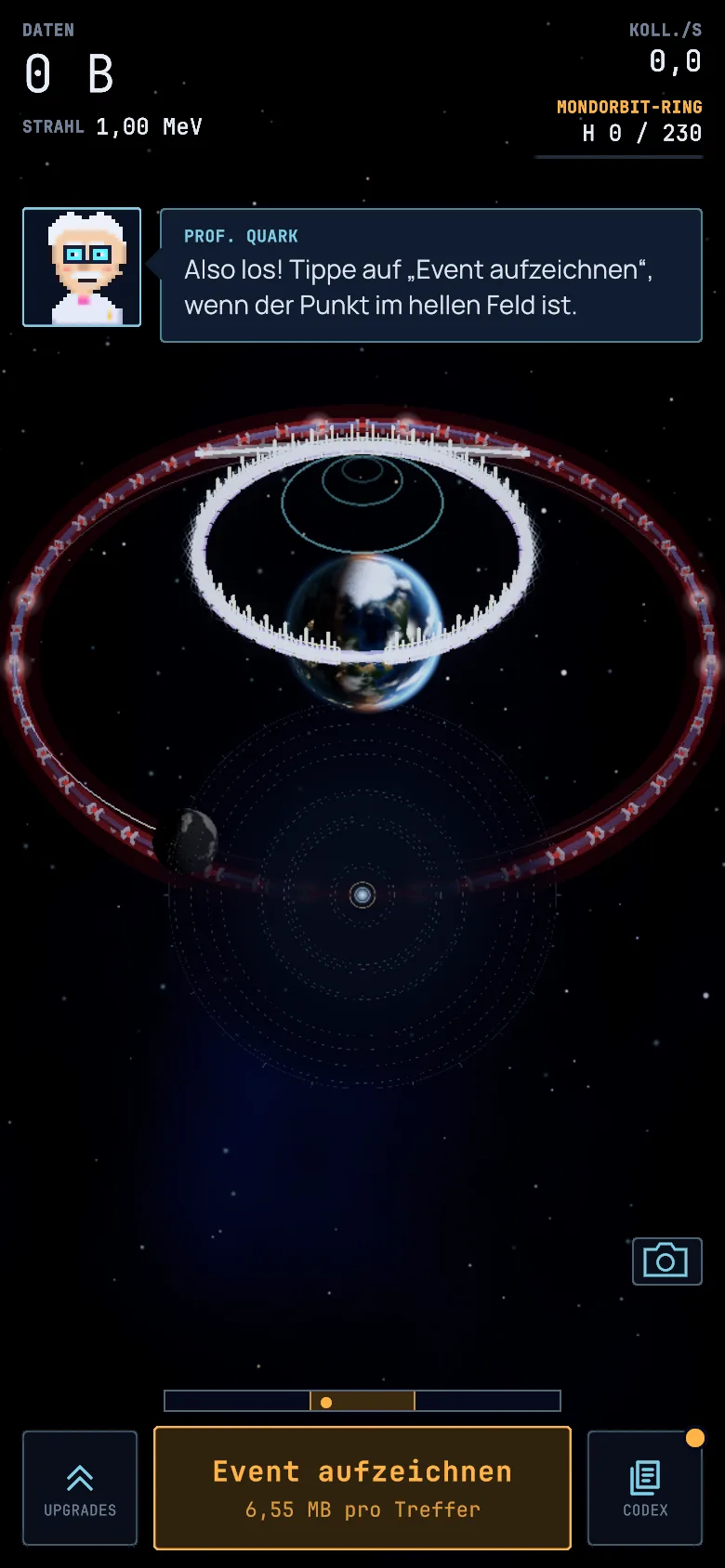
5Lunar orbit ring2.4 million km circumference40.92 TeV20 EeV200 Higgs×6.6Anomaly events (time boost, mass drop)
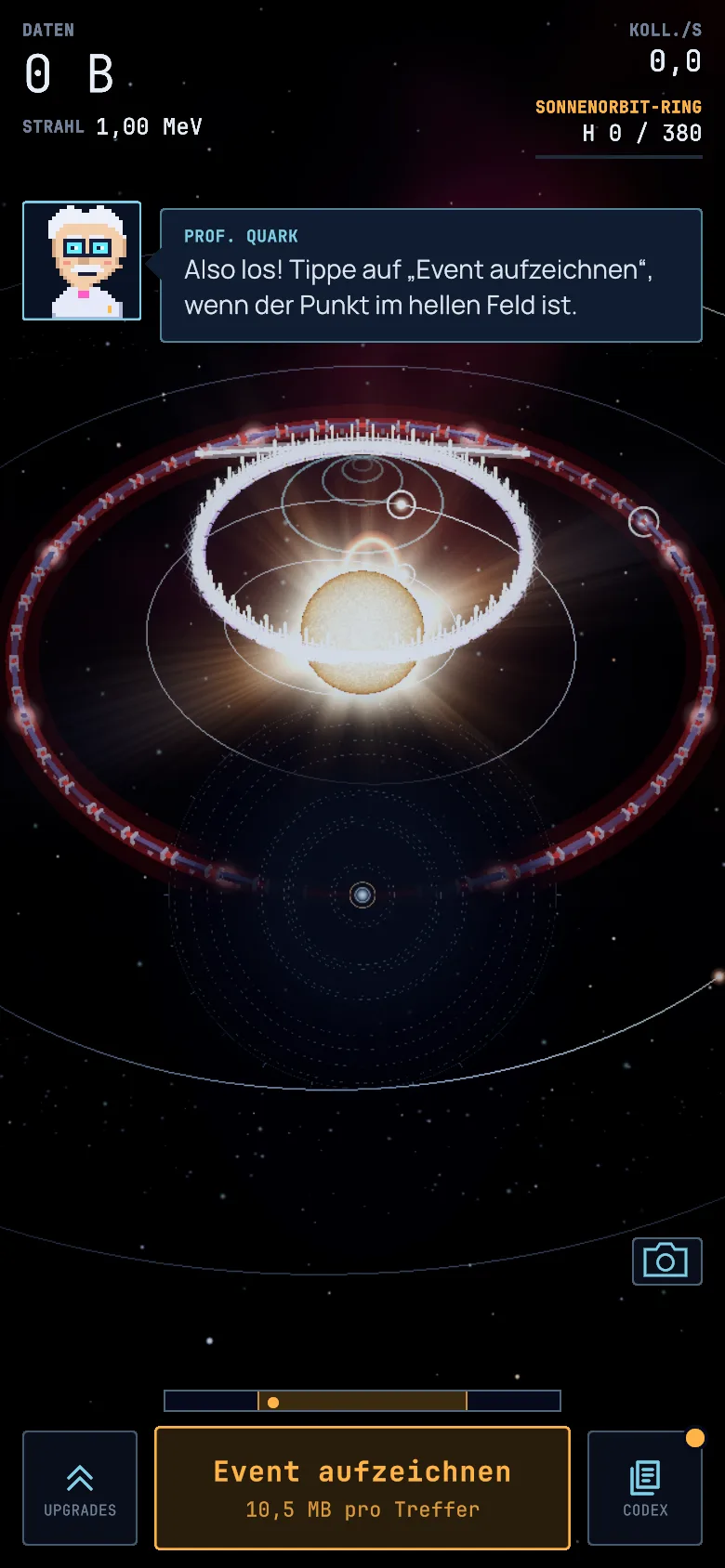
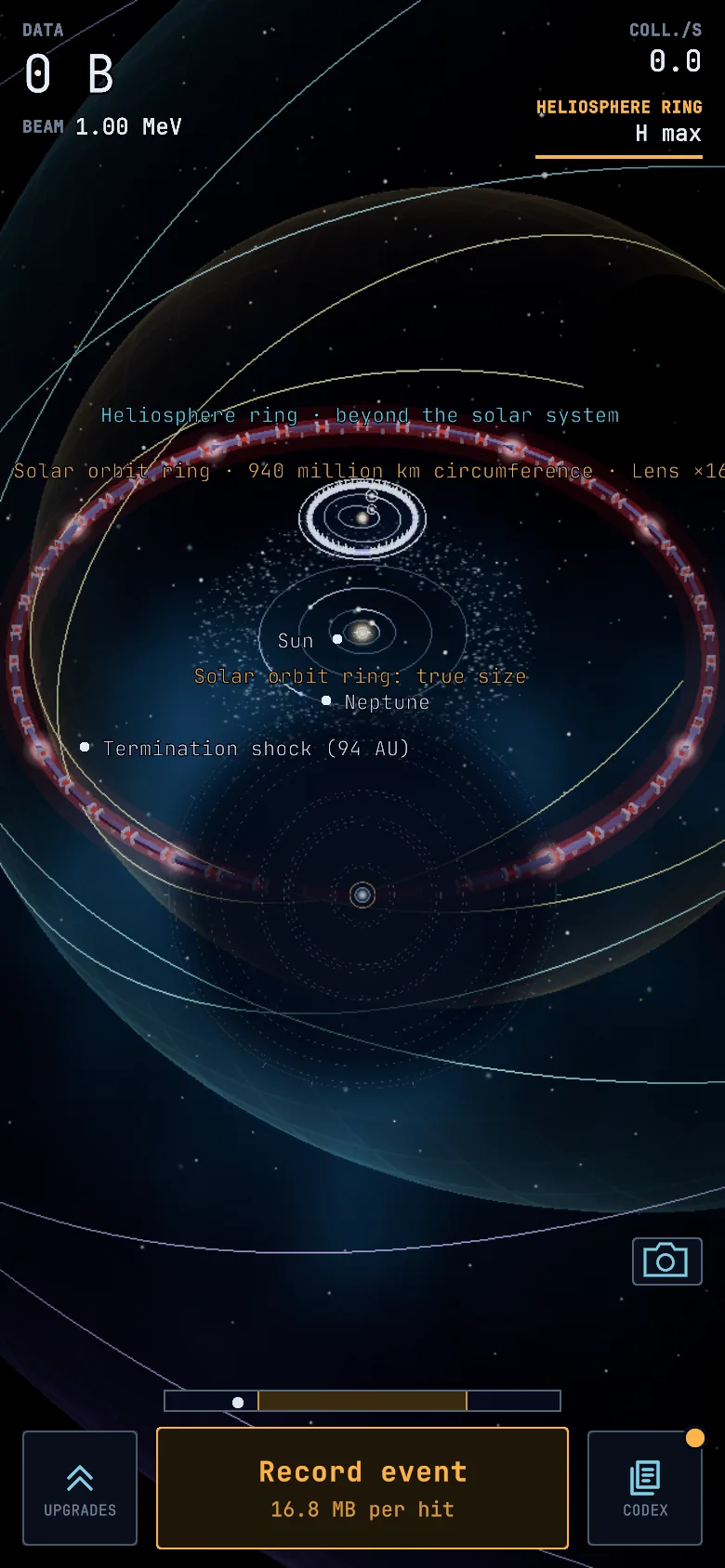
6Solar orbit ring940 million km circumference109.8 TeV2 ZeV230 Higgs×10.5Second detector: double beat
7Heliosphere ringbeyond the solar system140.6 TeVunlimited380 Higgs×16.8Every particle tunable as a resonance

Expanding the ring

Expanding costs Higgs bosons. It resets data, upgrades and particle stocks, keeps the codex and the mythic particles, raises the yield permanently by ×1.6 per ring, lifts the energy cap and adds the particles of the new ring to the roster. Every ring brings exactly one new mechanic.

PROF. QUARK

“New mechanic: luminosity starts at level 1 after the expansion, so the beam collides on its own from the start. Expanding resets data and upgrades; codex and mythic finds stay, and the yield rises permanently to ×1.6.”

Pre-accelerator and injection

The new ring does not start from zero. The previous ring stays inside it as a fully built, frozen pre-accelerator and injects the beam at about one fifteenth of the energy you typically reach in the new ring, much like the real SPS (450 GeV) feeds the LHC (7 TeV). Every beam level then builds the new ring up further.

Big accelerators do not start from zero: a smaller ring brings the beam up to injection energy. The SPS feeds the LHC protons at 450 GeV, and the LHC lifts them to 7 TeV – about fifteen times more. For the FCC, the LHC would be the pre-accelerator at roughly 3.3 TeV, with the new ring reaching around 50 TeV. The SPS sits inside the LHC circle but close to its edge near Meyrin; two short transfer lines (TI 2 and TI 8) feed the two LHC beams tangentially, one in each direction. The FCC plan puts the LHC at the edge of the 91 km ring in the same way.

PROF. QUARK

“The old ring (LHC ring) now serves as a pre-accelerator – like the SPS at CERN, which feeds the LHC at 450 GeV. So your beam starts at 375.8 GeV, about one fifteenth of what this ring can reach. You build the new ring up visibly with every beam level.”

The pre-accelerator chain of ring 1

  1. 1

    Linac (linear accelerator)

    At the start of the chain, Linac 4 accelerates negative hydrogen ions to 160 MeV; on injection into the Booster their electrons are stripped, leaving protons. A straight line needs no bending magnets and so emits no synchrotron light.

  2. 2

    Proton Synchrotron Booster

    The Booster consists of four stacked rings of 157 m circumference. It lifts the protons to 2 GeV and combines the bunches so the next synchrotron can be filled.

  3. 3

    Proton Synchrotron (PS)

    The PS started in 1959: 628 m circumference, protons up to 26 GeV, still the distribution hub of CERN. It shapes the bunches with the 25 ns spacing the LHC later needs.

  4. 4

    Super Proton Synchrotron (SPS)

    The SPS measures almost 7 km in circumference and accelerates protons to 450 GeV before they enter the LHC. In 1983, run as a proton–antiproton collider, it discovered the W and Z bosons. Two transfer lines lead the beams tangentially into the main ring.

Detector shells grow

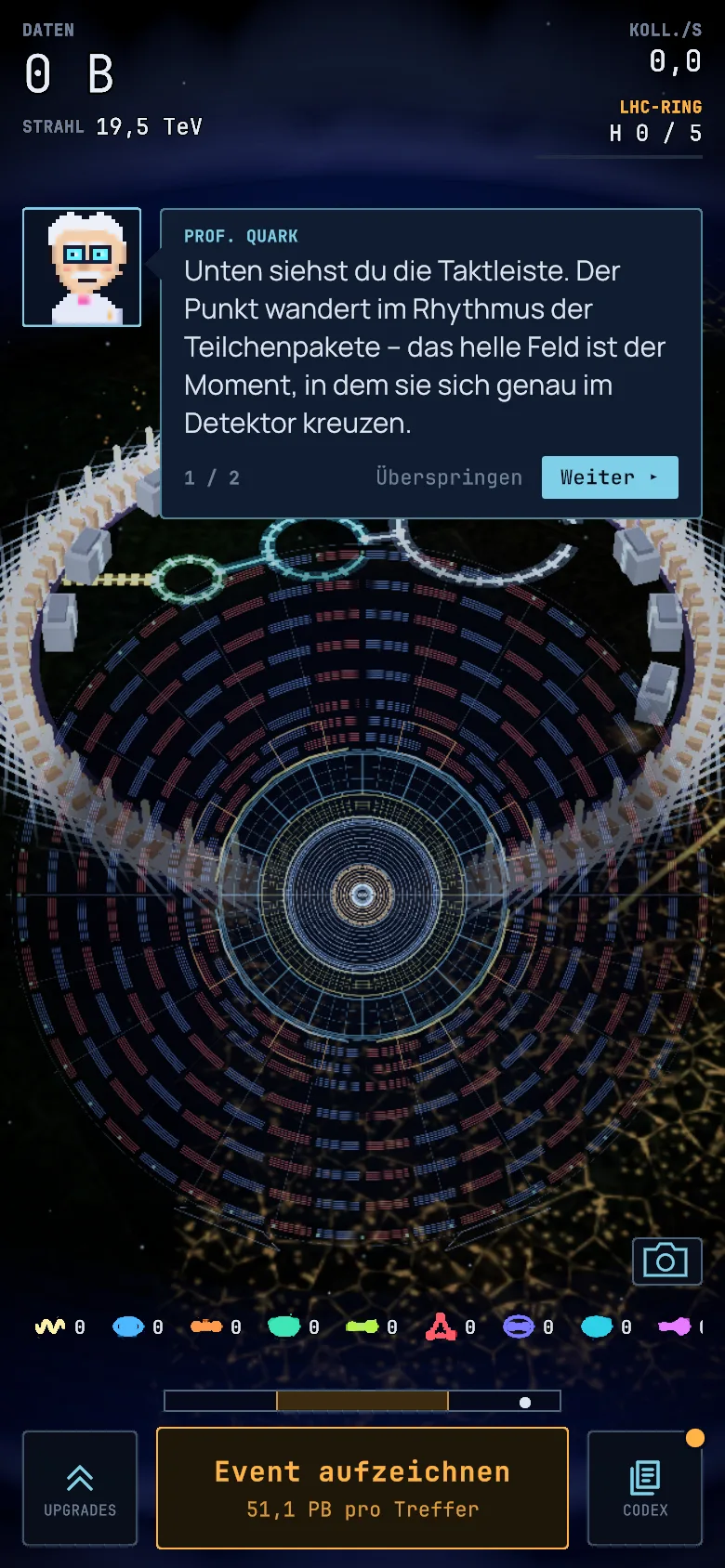
The detector around the collision point is built from shells. Each sub-detector level adds visible material, from the vertex layers inside to the muon chambers outside.

  • Beam pipe and collision point

    In the centre runs the beam pipe in ultra-high vacuum (about 10⁻¹⁰ mbar) so protons do not scatter off gas atoms; at the detector it is made of beryllium, which hardly slows particles. Here the counter-rotating bunches cross, and only a small fraction of the protons actually collide.

    All collisions happen here. The beam energy decides which particles can form.

  • Vertex detector

    The innermost layer of silicon pixels sits only a few centimetres from the collision point. It measures tracks to a few micrometres and finds where they originate. Particles such as B hadrons or the tau fly from a fraction of a millimetre up to several millimetres before they decay – a displaced secondary vertex gives them away.

    Boosts particles with displaced decays: τ, J/ψ, B hadrons, top, LQ and N.

  • Tracker

    Silicon strips and pixels measure the flight path of charged particles at many points. A magnetic field (CMS 3.8 T, ATLAS 2 T) bends the paths: the radius gives the momentum, p ≈ 0.3 · B · r (p in GeV/c, B in tesla, r in metres), the direction of the bend gives the sign of the charge. Neutral particles leave no track.

    Boosts charged particles that leave tracks: π, K, p, W and heavy charged particles.

  • Solenoid (magnet coil)

    A superconducting coil produces a field parallel to the beam axis (CMS 3.8 T, ATLAS 2 T). Charged particles move on arcs in it: the larger the momentum, the straighter the path. It is cooled with liquid helium to about 4.5 K.

    The coil grows with the magnetic-field upgrade, which also strengthens the ring's dipoles.

  • Electromagnetic calorimeter

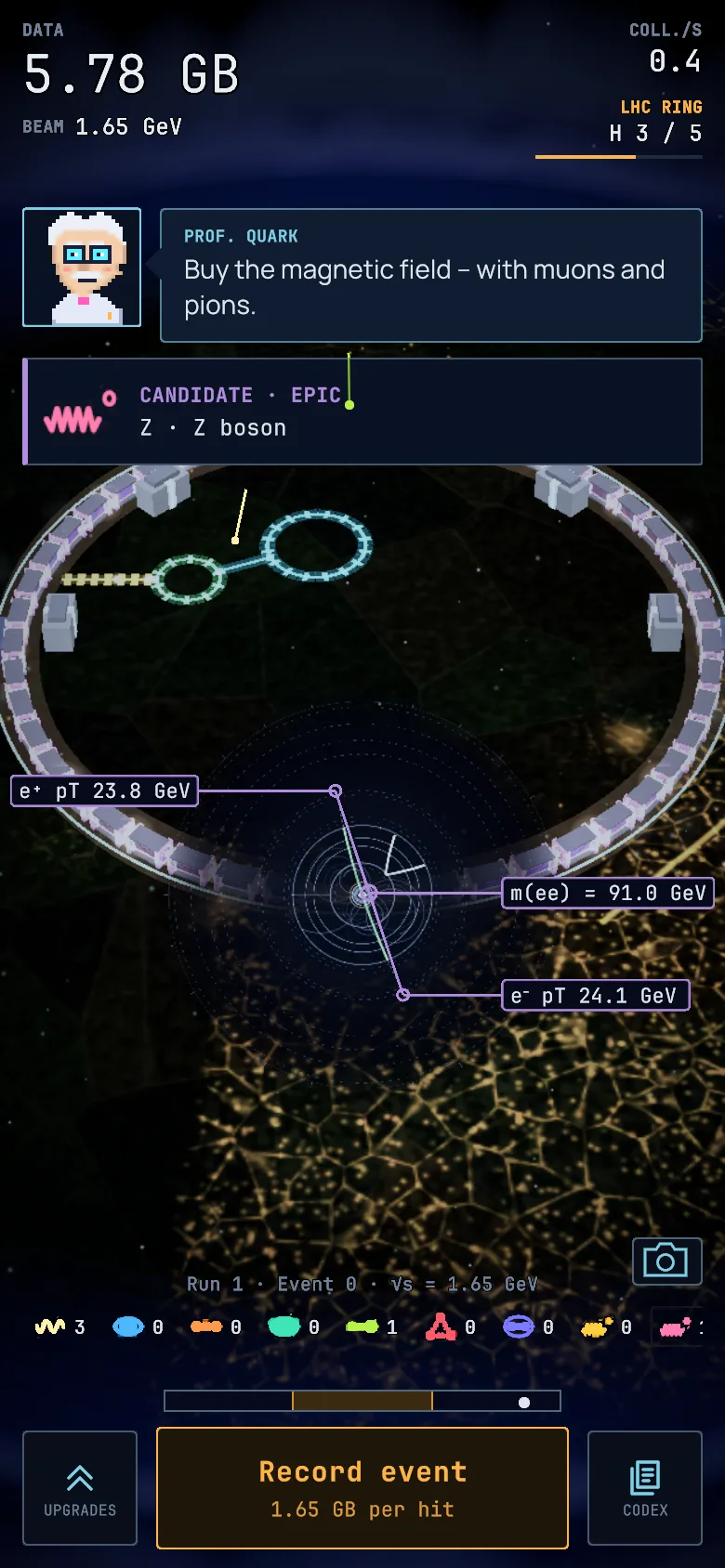
    Electrons and photons start a shower of electrons, positrons and photons in dense material until all the energy is absorbed and measured (ATLAS: lead and liquid argon, CMS: lead-tungstate crystals). The Higgs boson, too, was found in 2012 through decays into two photons.

    Boosts the electron, photon, Higgs and other particles that deposit their energy here.

  • Hadronic calorimeter

    Hadrons such as pions, protons or neutrons start cascades through the strong interaction in steel or brass (ATLAS and CMS respectively); the calorimeter thus measures the energy of whole jets. Neutrinos and muons pass through almost unseen.

    Part of the “Calorimeter” upgrade: the hadronic shell from level 3.

  • Muon system

    Muons are about 200 times heavier than electrons, radiate little and therefore penetrate everything in front of them. That is why the drift tubes and chambers sit on the outside: whatever still gives a signal there is almost always a muon. Decays like Z → μμ are thus especially clean to spot.

    Boosts the muon, Z, Z′ and A′. Higher levels add outer stations – the detector grows.

  • Toroid magnets

    ATLAS has eight large toroid coils around the beam axis. They create a second, ring-shaped field in the muon system where muons are bent once more – so their momentum is measured independently of the tracker. The detector is about 25 m high and 44 m long as a result.

    The eight coils appear with level 4 of the muon chambers.

Detector shells grow

The worlds

  1. LHC ring

    Ring 1 · 27 km circumference

    LHC ring

    Geneva basin

    The LHC lies 50 to 175 m underground on the border of Switzerland and France, between the Jura mountains to the north-west, the Alps to the south-east and Lake Geneva. The 26.7 km tunnel was originally dug for the electron–positron ring LEP, which started in 1989.

    Ring 1 is the LHC ring, 27 km in circumference with a 20 TeV energy cap. The upgrade to the FCC ring is in the ring tab.

    CERN site. CERN was founded in 1954 and is the world's largest particle physics laboratory. On the site stand the halls of the big experiments (ATLAS, CMS, ALICE, LHCb) with their detectors, which surround the beam at four points of the ring.

  2. FCC ring

    Ring 2 · 91 km circumference

    FCC ring

    Future Circular Collider (FCC)

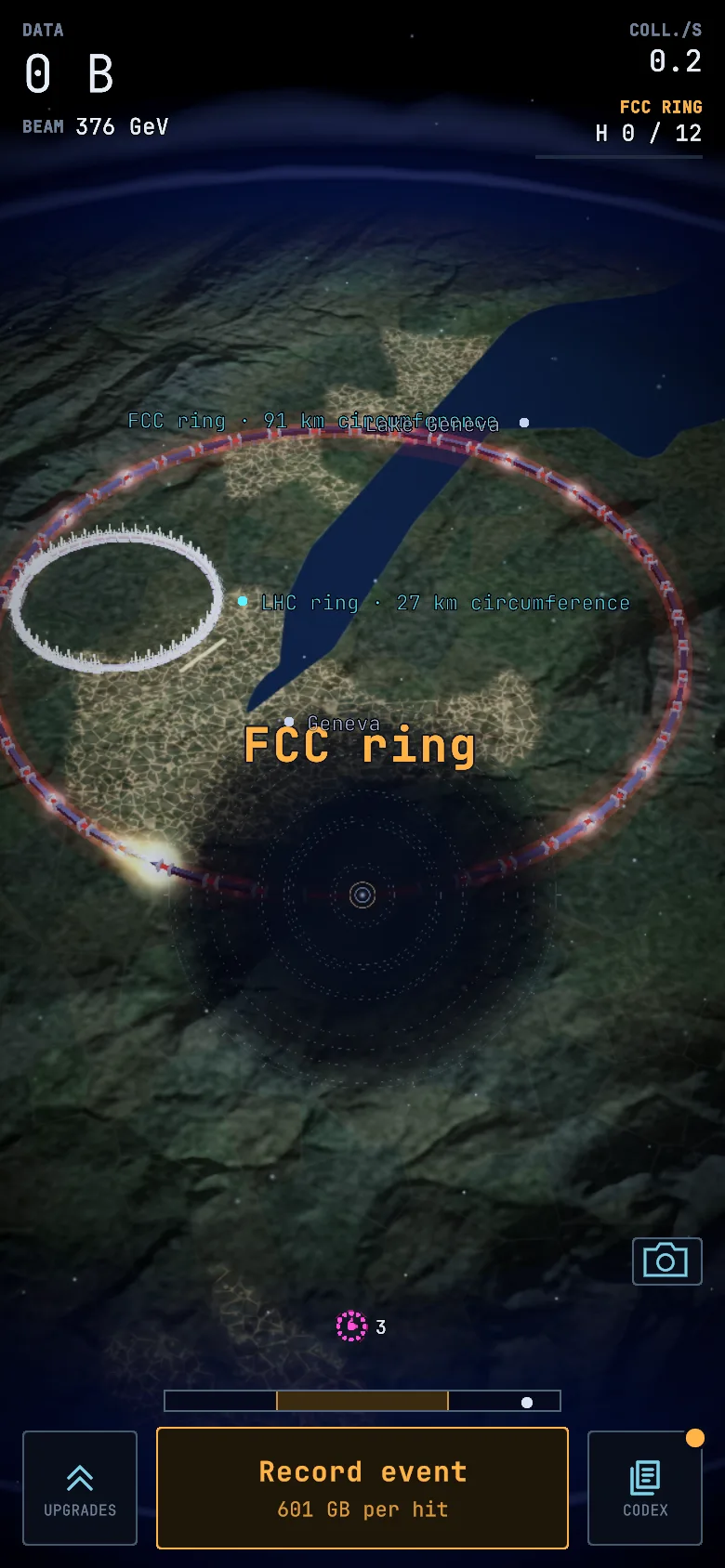
    The FCC is a plan studied at CERN for a ring tunnel of about 91 km: first as an electron–positron collider (FCC-ee, a Higgs and Z factory), later for protons (FCC-hh, roughly 85 to 100 TeV centre-of-mass energy). It has not been approved yet.

    Ring 2: the lake now lies inside the ring, the energy cap rises to 100 TeV, and luminosity starts at level 1.

  3. Continental ring

    Ring 3 · 3,000 km circumference

    Continental ring

    FUTURE FICTION · only the ring, not the celestial body

    Continental ring over Europe

    At fixed magnet strength the attainable energy grows with the radius (E ≈ 0.3 · B · r). A ring of 3000 km instead of 91 km circumference would, with the same magnets, reach over thirty times the energy of the FCC, i.e. a few PeV. Nobody is building such a thing.

    Ring 3: double beam – every tenth collision counts twice. The ring is future fiction.

  4. Earth ring

    Ring 4 · 40,000 km circumference

    Earth ring

    FUTURE FICTION · only the ring, not the celestial body

    Earth

    In 1954 Enrico Fermi calculated that an accelerator ring around the Earth with 2 T magnets would bring protons to about 5000 TeV – a thought experiment, not a plan. For comparison, the most energetic cosmic rays reach over 10²⁰ eV, millions of times more than the LHC.

    Ring 4 encloses the Earth (40,000 km), ring 5 circles it as the Moon's orbit, from ring 6 it is a dot on the ring. The rings are future fiction.

  5. Lunar orbit ring

    Ring 5 · 2.4 million km circumference

    Lunar orbit ring

    FUTURE FICTION · only the ring, not the celestial body

    Moon

    The Moon orbits the Earth at about 384,000 km, one orbit taking a little over 27 days. It always shows the same face (tidal locking) and raises the tides. A ring on its orbit would be about 2.4 million km in circumference.

    Ring 5: anomaly events – tap for a time boost or mass drop. The ring is future fiction.

  6. Solar orbit ring

    Ring 6 · 940 million km circumference

    Solar orbit ring

    FUTURE FICTION · only the ring, not the celestial body

    Sun

    The Sun is a fusion reactor: in its core hydrogen fuses into helium at about 15 million K. It emits the solar wind (protons at around 400 km/s) and neutrinos; about 6 · 10¹⁰ of them hit every square centimetre of the Earth each second, almost all of them unhindered.

    Ring 6: second detector – two crossings per turn, the beat is halved. The ring is future fiction.

  7. Heliosphere ring

    Ring 7 · beyond the solar system

    Heliosphere ring

    FUTURE FICTION · only the ring, not the celestial body

    Heliosphere

    The solar wind blows a bubble into the interstellar gas around the Sun. At the termination shock, about 85 to 95 AU away, it is slowed down; the heliopause at around 120 AU separates it from interstellar space. Voyager 1 crossed it in 2012, and the bubble shields us from part of the cosmic rays.

    Ring 7: every particle with mass can be reached as a resonance by tuning. The ring is future fiction.

Parts of the ring

Dipole magnet

Dipole magnets keep the particles on their circular path: the Lorentz force bends them, with p ≈ 0.3 · B · r. Higher energy needs a stronger field or a bigger ring. The LHC has 1232 superconducting dipoles, each about 15 m long, which produce 8.3 T at 1.9 K and hold 7 TeV protons on a 27 km circumference.

The “Magnetic field” upgrade strengthens the dipoles and wraps copper coils around them. Every 10 beam levels the whole ring gets a new era.

RF cavity

In radio-frequency cavities an electric field oscillates in step with the bunches: it accelerates them a little on every turn and keeps them together in bunches. The LHC has eight superconducting 400 MHz cavities per beam, about 2 MV each, 16 MV per beam in total.

Every 6 levels of beam energy add another RF module (at most 10).

Focusing quadrupole

Quadrupole magnets act like lenses: they focus the beam in one plane and defocus it in the other – placed alternately, they focus it overall. A triplet in front of the detector squeezes the beam to about 17 µm; the smaller the cross-section, the more collisions.

Every two levels of “Beam focus” add a triplet on each side of the detector (at most 6); focus also widens the hit window.

Cryogenic tank

Superconducting magnets lose all electrical resistance below a critical temperature. The LHC cools them with about 100 tonnes of liquid helium to 1.9 K – colder than empty space (2.7 K) – in the largest cryogenic plant in the world.

Each level of “Cryostat” adds another tank (at most 10) and extends offline operation.

Helium line

The liquid helium circulates in a pipe along the magnets. Below 2.17 K helium becomes superfluid: it conducts heat extremely well and has virtually no viscosity – ideal as a coolant for the magnets.

The line appears from level 2 of the “Cryostat” upgrade.

Beam and bunches

The protons do not run as a steady stream but in bunches. The LHC holds up to 2808 bunches per beam with about 10¹¹ protons each, 25 ns apart. Two beams run in opposite directions in separate pipes and cross only at the detectors – every crossing brings dozens of collisions.

You fire in step with the crossing (hit window). The “Luminosity” upgrade raises the number of collisions per second and unlocks automation.

Synchrotron light

Charged particles on a circular path radiate light tangentially. The power grows as E⁴ / (m⁴ · r²): at equal energy an electron loses about 10¹³ times more than a proton. That is why the LHC uses protons, and why at the electron ring LEP (104.5 GeV) radiation was the limit.

The light fans grow with the beam level: the higher the energy, the brighter and harder the light.